|

By Doron Markowitz
Hello again, and welcome
to another installment of Luthier’s Corner. For this
month’s interview, I was honored with the opportunity
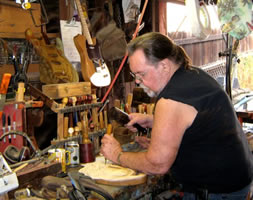
to speak with Doug Rowell, better known as Woodcarver Doug,
in Los Angeles, California. For those that don’t know,
Woodcarver Doug creates instruments that are equal parts music
and artwork, by taking a standard, average looking guitar,
and literally carving the most elaborate sculpture out of it!
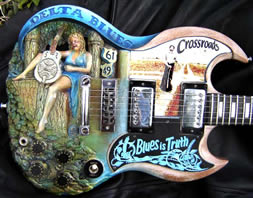
His creations are useable art. I have included some pictures
of his work so you can see what I mean. His work is extraordinary
and I learned so much about him and his craft through the course
of this discussion.
Doron: Hello Doug, and thank
you very much for taking the time to sit with me to talk
about the art of lutherie. I appreciate your time. Tell
me a little bit about how you got started carving guitars
and how you started Woodcarver Doug and what the company
philosophy is.
Doug: I started carving in Cub Scouts. They start you out with
neckerchief slides. Then I got interested in sculpting. My dad
always had wood working tools and I was always interested in drawing and art. So
it just seemed like a good fit. I started playing guitar in high school.
The
first guitar carving I did was an eagle shaped bridge for a Martin 000-21 I
had that had a cracked bridge. Later I carved some fowlers on a Fender
Mustang I bought cheap. Then I traded some carving on a roommate's Strat
for a month's rent. Someone saw his Strat at a session he played and
word of mouth started and I got some orders. |
|
|
Doron: How can
someone order a guitar from you?
Doug: I can be contacted by email or phone. Both
are on my website <http://www.carverdoug.com>
I'm also on Facebook under Doug Rowell. The guitars
on my site are mostly custom orders, already sold and gone. I
don't keep an inventory. It's all custom order. I
like to find out what a client's interests are and design
the carving around their particular tastes.
Doron: Did you do any other type
of wood working before beginning to craft guitars?
Doug: I have worked as a cabinet maker
and carpenter at various times. I worked for several
years as a carpenter building sets for TV shows at ABC
TV in Hollywood. |
Doron: What was it that made you decide
to devote your life to crafting instruments?
Doug: I wouldn't say my life is devoted to crafting
instruments. It's just something I enjoy doing. I
have the same passion for a number of other interests.
Doron: Did you find that the guitars
on the market lacked something that you thought you could improve
upon, which made you decide to become a luthier?
Doug: I'm not really a luthier, Doron. I've
never built or fretted a neck. I certainly don't wind pickups. I'm
a woodcarver. Whatever I bring to a guitar is purely cosmetic. I
do, on occasion, have to create a body because of the unique
design requirements of a particular instrument. But I'm
more of a sculptor than a luthier.
Doron: How long
have you been crafting stringed instruments?
Doug: About 40 years.
Doron: What do you look for in
tone woods?
Doug: I'm more interested in the grain
and consistency of a wood rather the tonal qualities.
Doron: Are there things unrelated
to the guitar that inspires a new idea or concept that
you incorporate into guitar building, like certain architecture,
or nature, etc? |
|
Doug:I'm a big fan art neuveau. You can
see the influence of that in many of my design concepts. But
I like to stay open to the tastes of the client. I've designed
landscapes, portraits, fantasy, cartoons and down right pornographic
concepts for my clients.
Doron: Where do you draw inspiration
from for some of your builds?
Doug: Mostly from the desire of clients
Doron: What is your philosophy in regards
to guitar crafting?
Doug: It should be playable. Look good,
play well and sound good.
Doron: I noticed that your guitars
are equal parts instrument and artwork/sculpture. How long
did it take you to hone your carving skills, and what was the
most difficult carving you have done to date?
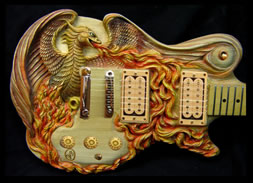
|
Doug: The most difficult guitars I think
are the portraits. They have to really look like
the person, not much artistic license there. The
most difficult of carving jobs in general were the 18 ft.
tall tree in Merv Griffin's yard or the 12' X 18' wall
carving for Kay Lenz (both on website) The
clubhouse table I carved for the "Sons of Anarchy" TV
show was hard because because it was big (5'X8') and had
to be done in 5 days.
Doron: How long does it typically
take to carve a guitar for an average client?
Doug: Most guitars take about 3 weeks,
depending on the difficulty of design, etc. and what else
I'm involved in at the time. |
Doron: Is the entire
guitar hand carved, or do you use CNC machines for any
part?
Doug: I never use CNC machines. Every
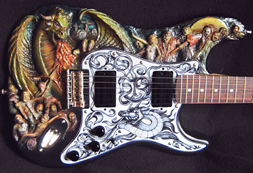
guitar is custom built and carved. The one exception
is the "Dragon Den" design. I carved the
original body and had 12 maple copies made on a multi-spindle
machine. But even these are only roughly carved and
have to have about 12-20 hours of carving and finishing
for completion.
Doron: Being a luthier myself,
I find that I love the smell of exotic woods as I cut
and shape them. What are some of your favorite species
of woods, scent-wise?
Doug: Scent wise, I'm partial to walnut,
rosewood, ash and purple heart. However I rarely
use dark woods for guitar bodies. Woods that are
lighter in color show off detail better on stage. |
|
Doron: What are some of your favorite
species of woods to work with, carving-wise?
Doug: For guitar, I think maple is the optimum. It's
very hard so it holds detail well. It's light enough to
show textures and airbrushing and has a crisp tonal quality. Of
course oak, mahogany, ash and alder are also good in their own
way.
Doron: Have you ever encountered a project that seemed
too much of a challenge for you to take on?
Doug: A client once wanted a representation of
thousands of slaves working on a diamond mine on the side of
a hill. Another wanted KISS performing on stage on a Telecaster. I
tried some sketches but couldn't really come with anything that
worked for both me and the client, Another man wanted me
to carve him a casket. I didn't want to spend time and
love on a thing designed to be buried in the ground.
 |
Doron: For anyone out there,
thinking of a career in lutherie, what kind of advice
would you give them?
Doug: I guess I'd have to suggest to aspiring
luthiers they should work with people who know what they're
doing. Read all the literature available for free
on line and take advantage of experts accessible through
Stewart MacDonald and other stringed instrument professionals.
Doron: Thank you so much for
taking the time out to talk with me today, Doug. I greatly
appreciate it. Before we go, is there anything else you
would like to share with our readers?
Doug: The thing I think I do best is listen
to my clients. My art, craftsmanship and designer
concepts have blossomed over the years attempting to give
customers what they want if I can find a way to do it. |
Doron: Thanks again.
OK so, I hope you enjoyed this month’s Corner and feel a bit more
informed. If I have answered any questions or curiosities that you had prior
to reading this, then I did my job.
Once again, thanks for reading my column and remember no task
worth accomplishing is ever achieved if not pursued with fierce
dedication. Believe in yourself, and make happen that glorious
noise called music! Until next time, remember, there is nothing
you can't do if you set your mind to it! Cheers!!
|
D
Guitars Miami has been a full-service repair and manufacturing
shop since 1988 serving South Florida with the highest
attention to detail one can expect. No job too big or
small. Whether you need pickups replaced, new frets,
a total refinish, broken head stock rebuilt, or just
want a custom crafted instrument built to your exacting
specifications, D Guitars Miami can do it all, from acoustic,
to electric, guitar or bass. (305) 896-1811 dguitarsmiami@yahoo.com |
| |
|
|