|
Each month we will be checkin what we feel is
an album that definitky may be worth revisiting. Sometimes it
is easy to forget how great some of these releases were. Many
of them went on to have signifigant influence on the music of
today. When going back and checking them out again you will often
find forgotten brilliance and just maybe it will give you a
new spark of inspiration for creating something awesome on
your own. (-: Thanks to Wikapedia
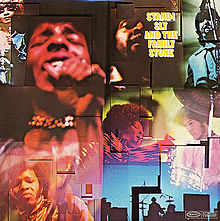
Stand! is the fourth studio album by
soul/funk band Sly and the Family Stone, released May 3, 1969 on Epic
Records. Written and produced by lead singer and multi-instrumentalist
Sly Stone, Stand! was the band's breakout album.It went on to sell over
three million copies and become one of the most successful albums of
the 1960s.The album sold over 500,000 copies in the year of its release
and was certified gold in sales by the Recording Industry Association
of America on December 4, 1969. By 1986, it had sold well over 1 million
copies and had been certified platinum in sales by the RIAA on November
26 of that same year.
Stand! is considered one of the artistic high-points
of the band's career and includes several landmark songs, among them
hit singles, such as "Sing a Simple Song", "I Want to
Take You Higher", "Stand!", and "Everyday People".
In 2003, the album was ranked number 118 on Rolling Stone magazine's
list of the 500 greatest albums of all timeThis album published in UK
only as reissued CD in 2007 with bonus tracks.This album published in
US as LP record with gatefold cover in 1969, and as reissued LP record
and CD in 1990. In 2007 it was reissued as remastered numbered edition
digipack CD with bonus tracks. |
 |
Production
Stand! was recorded after Life, a commercially unsuccessful
album. Despite the Family Stone's early 1968 single "Dance to the Music" being
a top ten hit in the United States, none of the band's first three albums charted
above 100 on the Billboard 200. Stand! broke this trend, reaching number thirteen
on the Billboard 200, and launching Sly Stone and his bandmates Freddie Stone,
Larry Graham, Rose Stone, Cynthia Robinson, Jerry Martini, and Greg Errico
into the pop music mainstream.
Much of the album was recorded in the San Francisco area
at studios such as Pacific High Recording Studios. The band’s A&R director and photographer
Stephen Paley recalled how "together" Sly Stone was while working
on Stand!, down to his constant referencing of Orchestration, a how-to book
on orchestral arrangement by Walter Piston. Stone's attitude while working
on the album would contrast sharply with the erratic behavior and work ethic
he would develop after becoming dependent upon cocaine within a year of the
release of Stand!
Stand! begins with the title track. Sly Stone sings lead
on "Stand",
which plays out as a mid-tempo number for two minutes before launching into
a gospel break for the final forty-nine seconds of the song.Most of the
Family Stone was unavailable for the session where Sly recorded the final version
of the gospel extension, and he, drummer Gregg Errico, and horn players Cynthia
Robinson and Jerry Martini used session players instead. Errico recalls that
many liked the gospel extension more than they did the song proper: "People
would always ask, 'why didn't you go there and let that be the song?'"The
second track on the album is "Don't Call Me Nigger, Whitey",
a criticism of racism. The song has very few lyrics, save for a verse by Rose
Stone and the song's chorus: Don't call me "nigger", whitey./Don't
call me "whitey", nigger. Once "Don't Call Me Nigger, Whitey" concludes,
the album launches into the high-tempo "I Want to Take You Higher".
Freddie Stone, Larry Graham, Rose Stone, and Sly Stone each take turns delivering
the lead vocal. All seven members of the band deliver the shouted backing vocals
on the recording, and Sly Stone, Robinson, Freddie Stone, Graham, and Martini
are all given instrumental solos.
"Somebody's Watching You" follows "I Want to Take You Higher",
and is a somber number about paranoia. Sly Stone, Graham, Freddie Stone, and
Rose Stone deliver the song's lead vocal in unison, with the song lyrics reflecting
the constant need for a successful person to always have to watch his back.
The song's slightly pessimistic tone would be expanded upon later in the band's
career with "Thank You (Falettinme Be Mice Elf Agin)" and the There's
a Riot Goin' On LP. "Somebody's Watching You" would be covered
as a Top 40 hit for the Family Stone's background vocal group, Little Sister,
whose version was the first Top 40 single to feature use of a drum machine.
Side A concludes with "Sing a Simple Song", which urges the audience
to "sing a simple song" and "try a little do re mi fa so la
ti do". Motown artists such as Diana Ross & the Supremes, The Temptations,
and The Jackson 5 recorded covers of "Sing a Simple Song", and the
song's guitar riff can be heard on the recordings of Ike & Tina Turner
("Bold Soul Sister" from The Hunter, 1969), Jimi Hendrix (Band of
Gypsys, 1970), and Miles Davis (A Tribute to Jack Johnson, 1971).
"Everyday People", already a number-one hit single in the United
States by the time of the album's release, opens Side B. The most familiar
selection on the album, "Everyday People" criticises racism and prejudice,
and popularized the expression "different strokes for different folks".[18]
Sly Stone, Rose Stone, and Cynthia Robinson sing lead on the song, and Larry
Graham introduced the beginnings of the slap-pop style of bass playing he would
later expand upon for "Thank You (Falettinme Be Mice Elf Agin)".
The second track on Side B is "Sex Machine", a thirteen-minute jam,
which features Sly again scatting through a vocoder, and allowing each band
member an extended solo. Gregg Errico's solo closes out the song; while he
was recording his solo, the other band members were apparently standing around
him and making fun of him, which is why they are all heard bursting into laughter
during the final seconds of the track. Stand! concludes with "You Can
Make It If You Try", sung by Sly Stone, Freddie Stone, and Larry Graham.
For this track, Sly Stone played the bass instead of Larry Graham.
Influence
Stand! is among the most sampled recordings in popular
music history; late 20th century hip hop producers were particularly fond
of sampling Gregg Errico's drum lines from "Sing a Simple Song" and "You
Can Make It If You Try", and either looping the tracks or chopping them
up and using the drum sounds. The drums from these two tracks can be found
on literally hundreds of hip-hop and contemporary R&B songs, by artists
such as LL Cool J, The Jungle Brothers, Digital Underground, Ice Cube, TLC,
Jodeci, and many more.[19] Arrested Development, an act heavily influenced
by Sly & the Family Stone, borrowed from some of the tracks on Stand! for
various tracks on their 1992 debut album 3 Years, 5 Months & 2 Days in
the Life Of.... Several 3 Years, 5 Months... tracks contain samples of Stand!
tracks, most prominently the vocals samples from the end of "Sing a Simple
Song" included in Arrested Development's "Mr. Wendel", their "People
Everyday" borrows the chorus from "Everyday People", and the
coda of "Fishin' For Religion" mirrors the gospel ending of "Stand".
|