|
Hello
again, and welcome to the sixth installment of Luthier’s
Corner. This month, I’d like to discuss a topic that
craftsmen and luthiers have dealt with for eons, that of
tone woods. Or rather, address questions that I am often
asked regarding tone woods, such as “what makes one
wood a tone wood over that which isn’t?” “What
are the differences in the various species of tone woods?” etc.
When
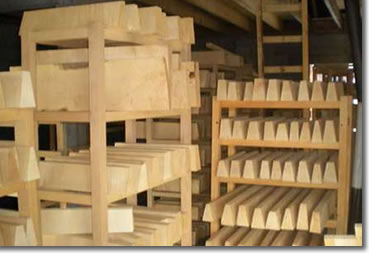
it comes to knowing what a tone wood is, it’s also important to know
what type of wood is NOT considered a tone wood.
This will save a lot of headache for you, in case
you decide to build a guitar out something like teak,
NOT a tone wood. Now when I first started building
guitars, I went by what I was told or read as to
what the most common tone woods are to start with,
which was a short list being maple, mahogany, ash,
alder, rosewood and ebony. As time went on, and as
I did more research and experimenting, I found that
there are a LOT of useful tone woods out there that
not only sound fantastic, but many of which have
some gorgeous colors and grains.
Bear in mind also
that part of this search for alternative woods was
due to many of the tone woods, referenced early on
to me, either becoming endangered or even extinct.
This does not mean that one can’t build a fine
playing and sounding guitar, because they can’t
get their hands on a piece of Brazilian Rosewood
anymore without paying through the nose. It simply
means that you should look at it as an opportunity
to “think outside the box.” Conversely,
there have been countless guitars built over the
years that have used timber that normally would not
be considered tone woods, and are some of the most
glorious sounding guitars ever! |
|
The perfect
example is Brian May’s Red Special. Those that know
me know that I regard that particular guitar as one of
the greatest innovative guitars ever built, but what were
the woods used? Would you believe that the body was basically
plywood and a slab of red oak? More specifically, the main
body frame was built from 2 pieces of blockboard, commonly
used for doors, bolted together, and a center core of red
oak! The neck was made from 100 year old mahogany that
was actually not a very good piece to start with, and the
fingerboard, although looking like ebony, is actually red
oak painted almost black! Now listen to any Queen record
and tell me that guitar doesn’t sound incredible!!
The point is that although there is a certain “list” of
tone woods that are instrument grade, that does not mean
that one cannot use alternative materials or woods to build
an incredible sounding guitar. I, for instance, have built
some of the finest sounding and playing guitars of my career
using woods that I bought solely at Home Depot , Builder’s
Square, or Lowes, namely poplar, red oak, and maple. Keep
in mind also that not only are guitars built from wood,
but there are many that are built from materials such as
lucite, aluminum, carbon graphite, and other non wood materials.
Teak looks pretty, and is awesome for building
boats, but not good for instruments
OK so what are tone woods and what
aren’t, and what
does each tone wood sound like overall? Well first off,
the way to determine if a piece of timber is instrument
grade tone wood is to do the tap test. Basically, you hold
the piece of wood near your ear and then thump it with
your thumb. If you actually hear a certain echoing ring
or hum from the wood, it’s a tone wood. Naturally
the “tone” of the thump changes as the wood
is shaved, carved, etc. If you thump it and all you hear
is a thud, and the thud immediately decays, it’s
furniture grade wood, not tone wood. This is important
because the last thing you want to do is use a slab of
wood that looks gorgeous, but causes your guitar to have
no resonance, sustain, or musical quality, hence my earlier
teak reference. Teak is the perfect example of a tonally
dead piece of wood. It looks pretty, and is awesome for
building boats, but not good for instruments. Another thing
you want to remember is that the best type of wood to use
for building an instrument is hard wood, not soft woods,
such as pine, fir, white wood, etc. Of course, again, depending
on the application, there are exceptions to every rule.
After all, Leo Fender built the first Broadcaster prototype
with a pine body. Depending on the application, one could
get away with using a wood such as pine, if it’s
not for a structural part, such as the neck. That’s
why you’ll never see any guitar built entirely out
of balsa!
|
OK,
so due to various species of timber becoming endangered,
luthiers and companies started looking for various
alternative woods that are of instrument grade
quality. And guess what, some of the most beautiful
looking and sounding woods are exotic pieces that
look as if they were dyed or painted their unusual
colors, and also are some of my favorites! Hey,
I’m old school,
so if I have my preference, I would want stacks of
good Brazilian mahogany, Brazilian rosewood, and
curly maple.
But, 2 of those species are highly endangered.
Care to guess which 2? Hint, they are both Brazilian.
However, over the years, I have come to fall in love
with certain exotics that are as toneful and strong
as they are gorgeous to look at. One of my favorites
is purpleheart, so named because it literally is
purple in color. Very dense, and very heavy, it makes
a great tone wood, but I would NEVER build an entire
guitar out of due to its weight. No, I usually prefer
to build my guitars using multiple pieces of wood
so that I can create a sort of tone wood mosaic,
which also helps keep the weight in check. Other
exotics that I absolutely love are paduak, which
has a sort of orangey brownish orange color to it,
also very dense, but not as heavy as purpleheart. |
Then there is wenge, which has contrasting
dark and light chocolate brown streaks in it. Another gorgeous
tone wood. Of course, one of my all time favorites, albeit
a bit on the pricey side, is cocobolo. Just Google Cocobolo
and look at a picture of it. The colors and grain are breathtaking!
Dark browns, with light beige streaks, long sweeping cathedral
grains, simply amazing! There is also zebrano, or zebrawood,
which looks as it sounds, like a zebra wood, dark and light
streaks of color that look so evenly spaced, it’s
amazing. Then there are other exotics I also love working
with that have beautiful color but perhaps not as fancy
a grain, such as bubinga, which has a sort of pinkish hue
to the color. Sometimes you can find a piece that has some
nice curl in the grain. That’s always cool.
OK so you’re wondering what are the tonal differences
between all these woods? Well, in a nutshell, the tonality
of a particular piece of wood is dependent on certain factors,
such as density, grain structure, and weight. Short grained,
porous woods, such as mahogany, tend to sound a bit darker
or muddy due to how the string resonance actually gets “sucked” into
the pores of the wood. Listen to a guitar that has an all
mahogany body versus a similar guitar with an all maple
body. They sound completely different. The mahogany will
tend to sound bassier and thicker, whereas the maple body
will tend to sound brighter and punchier. That’s
because maple is a long grain, tight pore wood. Long grain
woods tend to be brighter, with a tighter bass resonance
and brighter highs. That’s one of the reasons that
one of the most popular combinations are mahogany bodies
with a maple top. It’s a perfect blend of deep, yet
tight bass response, while having thicker, yet more defined
highs and mids.
Well, it seems that I really went long with this article,
so in the next issue, I will discuss the further tonal
differences between the various exotic and domestic timbers
used in instrument making.
Once again, thanks for reading my column and remember no
task worth accomplishing is ever achieved if not pursued
with fierce dedication. Believe in yourself, and make happen
that glorious noise called music! Until next time, remember,
there is nothing you can't do if you set your mind to it!
Cheers!!
|