Each
month we will be checkin what we feel is an album that definitky
may be worth revisiting. Sometimes it is easy to forget how
great some of these releases were. Many of them went on to
have signifigant influence on the music of today. When going
back and checking them out again you will often find forgotten
brilliance and just maybe it will give you a new spark of inspiration
for creating something awesome on your own. (-: Thanks
to Wikapedia
The Rise and Fall of
Ziggy Stardust and the Spiders from Mars (often shortened
to Ziggy Stardust) is a 1972 concept album by English
musician David Bowie, which is loosely based on a story
of a fictional rock star named Ziggy Stardust. It peaked
at number five in the United Kingdomand number 75 in
the United States on the Billboard Music Charts.
The album tells the story of Bowie's
alter-ego Ziggy Stardust, an alien who visits Earth
in the form of a rock star. Bowie created Ziggy Stardust
while in New York City promoting Hunky Dory and performed
as him on a tour of the United Kingdom, Japan and North
America. The album, and the character of Ziggy Stardust,
was known for its glam rock influences and themes of
sexual exploration and social commentary. It has been
consistently considered as one of the greatest albums
of all time, with Rolling Stone ranking the record
the 35th greatest ever. It was ranked the 20th greatest
album ever in a 1997 British survey, the 24th greatest
of all time by Q magazine and one of the 100 greatest
releases ever by Time magazine. |
|
A concert film of the same name directed
by D.A. Pennebaker was released in 1973.
The album presents, albeit vaguely, the story of a rock and
roll character called "Ziggy Stardust".Ziggy
is the human manifestation of an alien being who is attempting
to present humanity with a message of hope in the last five
years of its existence. Ziggy Stardust is the definitive
rock star: sexually promiscuous, wild in drug intake and
with a message, ultimately, of peace and love; but he is
destroyed both by his own excesses, and by the fans he inspired.
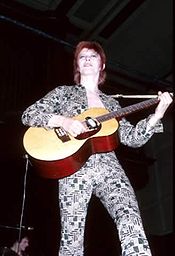
David Bowie during the Ziggy Stardust Tour.The character
of Ziggy was inspired by British rock 'n' roll singer Vince
Taylor whom Bowie met after Taylor had had a breakdown
and believed himself to be a cross between a god and an
alien; though Taylor was only part of the blueprint
for the character,other influences included the Legendary
Stardust Cowboy and Kansai Yamamoto, who designed the
costumes Bowie wore during the tour. The Ziggy Stardust
name came partly from the Legendary Stardust Cowboy, and
partly, as Bowie told Rolling Stone, because Ziggy was "one
of the few Christian names I could find beginning with
the letter 'Z'".He later explained in a 1990
interview for Q Magazine that the Ziggy part came from
a tailor's shop called Ziggy's that he passed on a train,
and he liked it because it had "that Iggy [as in Iggy
Pop] connotation but it was a tailor's shop, and I thought,
Well, this whole thing is gonna be about clothes, so it
was my own little joke calling him Ziggy. So Ziggy Stardust
was a real compilation of things."
Legendary Stardust Cowboy song
Bowie covered a Legendary Stardust
Cowboy song, "I
Took a Trip (On a Gemini Spaceship)" thirty years later
on Heathen. ProductionThe Ziggy Stardust sessions
began just a few weeks after Hunky Dory was released. The
first song recorded for the album, the cover "It Ain't
Easy",
was recorded in September 1971. The first session in November
produced "Hang on to Yourself", "Ziggy Stardust", "Rock
'n' Roll Star" (later shortened to "Star"), "Moonage
Daydream", "Soul Love", "Lady Stardust",
and "Five Years".
Also recorded during the November Ziggy
Sessions were two more cover songs intended for the as-yet
untitled album. They were Chuck Berry's "Around and Around" (re-titled "Round
and Round") and Jacques Brel's "Amsterdam" (re-titled "Port
of Amsterdam"). A re-recording of "Holy Holy" (first
recorded in 1970 and released as a single, to poor sales,
in January 1971) was initially slated for Ziggy, but was
dropped in favour of "Rock 'n' Roll Suicide". "Round
and Round" was replaced by "Starman" and "It
Ain't Easy" replaced "Amsterdam" on the album's
final running order. All three were eventually released as
b-sides.
"Velvet Goldmine", first recorded during the Hunky
Dory sessions, was also intended for Ziggy, but was replaced
by "Suffragette City". RCA released it in 1975
as the b-side to the UK re-release of "Space Oddity" after
having it remixed and mastered without Bowie's approval.
After recording some of the new songs
for Sounds of the 70s with Bob Harris (which appear on
Bowie at the Beeb) as the newly-dubbed Spiders from Mars
in January–February
1972, the band returned to Trident. They recorded "Starman", "Suffragette
City", and "Rock 'n' Roll Suicide" by the
end of the month.
"Starman", released as a single in April (and
not intended for the final album at first), has never appeared
in its original "loud" mix on CD. It differs somewhat
in that it "features a subdued 'morse code' section
between the verse and the chorus"compared to the
original released in 1972. "Suffragette City",
the b-side to "Starman", was mastered for the album
with a three-note coda leading in from "Ziggy Stardust" to
make the songs sound linked. They were never played as such
by Bowie in concert.
Recorded and released during the ensuing
Ziggy tour were two other songs. The first, "John,
I'm Only Dancing",
was recorded at Trident in late June and released (in the
UK only) in September. "The Jean Genie", recorded
at RCA Studios in New York in early October at the start
of the American tour, was released in the US in November.
The song was remixed for Aladdin Sane.Rock keyboardist Rick
Wakeman was given the opportunity to play keyboards on the
album but Rick opted to join the progressive rock group Yes
instead.
Ziggy Stardust story
|
The album was intended
by Bowie to serve as the soundtrack and musical basis
for a stage show and/or television production telling
the story of Ziggy Stardust.[citation needed] As well
as the songs on the album, Bowie also intended songs
such as "All the Young Dudes", "Rebel
Rebel" and "Rock 'n' Roll With Me" (the
latter two later recorded for Diamond Dogs) for this
realisation of the Ziggy story.
The time is five years to go before
the end of the earth. It has been announced that the
world will end because of lack of natural resources.
Ziggy is in a position where all the kids have access
to things that they thought they wanted. The older
people have lost all touch with reality and the kids
are left on their own to plunder anything. Ziggy was
in a rock-and-roll band and the kids no longer want
rock-and-roll.
There's no electricity to play it.
Ziggy's adviser tells him to collect news and sing
it, 'cause there is no news. So Ziggy does this and
there is terrible news. 'All the young dudes' is a
song about this news. It's no hymn to the youth as
people thought. It is completely the opposite.
The end comes when the infinites arrive. They really
are a black hole, but I've made them people because
it would be very hard to explain a black hole on stage. |
Ziggy is advised in a dream by the infinites
to write the coming of a Starman, so he writes 'Starman',
which is the first news of hope that the people have heard.
So they latch onto it immediately...The starmen that he is
talking about are called the infinites, and they are black-hole
jumpers. Ziggy has been talking about this amazing spaceman
who will be coming down to save the earth. They arrive somewhere
in Greenwich Village. They don't have a care in the world
and are of no possible use to us. They just happened to stumble
into our universe by black hole jumping. Their whole life
is travelling from universe to universe. In the stage show,
one of them resembles Brando, another one is a Black New
Yorker. I even have one called Queenie, the Infinite Fox...Now
Ziggy starts to believe in all this himself and thinks himself
a prophet of the future starmen. He takes himself up to the
incredible spiritual heights and is kept alive by his disciples.
When the infinites arrive, they take bits of Ziggy to make
them real because in their original state they are anti-matter
and cannot exist in our world. And they tear him to pieces
on stage during the song 'Rock 'n' roll suicide'. As soon
as Ziggy dies on stage the infinites take his elements and
make themselves visible
Upon its release on 6 June 1972, Ziggy Stardust reached
number five in the UK and number seventy-five in the US.
The album was eventually certified platinum and gold in the
UK and US respectively.The only single from the
record, "Starman", charted at number ten in the
UK while peaking at the sixty-fifth spot in the US. In the
issue of Rolling Stone from 20 July 1972, writer Richard
Cromelin gave the album a favourable review of "at
least a 99" (assumed out of 100); the review was written
in a way that even though he thought it was a good album,
he did not believe in the lasting power of it or the style
in general. In his review Cromelin writes "we should
all say a brief prayer that his fortunes are not made to
rise and fall with the fate of the 'drag-rock' syndrome".
In 1987, as part of their 20th
anniversary, Rolling Stone magazine ranked it #6 on "The 100 Best
Albums of the Last Twenty Years." In 1997, Ziggy Stardust
was named the 20th greatest album of all time in a Music
of the Millennium poll conducted in the United Kingdom by
HMV Group, Channel 4, The Guardian and Classic FM. In 1998,
Q magazine readers placed it at number 24 and Virgin All-time
Top 1000 Albums ranked it at number 11, while in 2003 the
TV network VH1 placed it at number 48. It was named the 35th
best album ever made by Rolling Stone on their list of the
500 Greatest Albums of All Time. In 2000 Q placed it at number
25 in its list of the 100 Greatest British Albums Ever. In
2004 it was placed at number 81 in Pitchfork Media's Top
100 Albums of the 1970s. In his 1995 book, "The Alternative
Music Almanac", Alan Cross placed the album in the #3
spot on the list of '10 Classic Alternative Albums'. In 2006,
the album was chosen by TIME magazine as one of the 100 best
albums of all time.
In 2005, Brazilian singer Seu Jorge
did a cover album of 14 Bowie songs, many of them from
Ziggy Stardust, as a soundtrack for the movie The Life
Aquatic with Steve Zissou called The Life Aquatic Studio
Sessions. The translation into Portuguese is not always
exact, as Seu Jorge maintains the melodies and styles,
but often varies the lyrics. Bowie himself said of Seu
Jorge's covers: "Had Seu Jorge not recorded my
songs in Portuguese I would never have heard this new level
of beauty which he has imbued them with". Musician
Saul Williams named his 2007 Trent Reznor-produced album
The Inevitable Rise and Liberation of NiggyTardust!. In 2009,
Techno Cowboy covered the entire album from start to finish
using just the Omnichord called "The Ziggy Stardust
Omnichord Album".
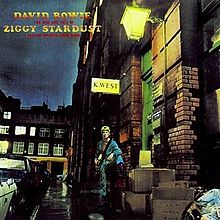
In 2012, on the 40th anniversary of the album's
release, a commemorative plaque was unveiled at the location
of the cover photo on Heddon Street in London. The album
cover photograph was taken outside furriers "K. West" at
23 Heddon Street, London, W1.,looking south-east towards
the centre of the city. The post office in the background
(now "The Living Room,
W1" bar) was the site of London's first nightclub, The
Cave of the Golden Calf, which opened in 1912. As part of
street renovations, in April 1997 a red "K series" phonebox
was returned to the street, replacing a modern blue phonebox,
which in turn had replaced the original phonebox featured
on the rear cover.
The cover was among the ten chosen
by the Royal Mail for a set of "Classic Album Cover" postage stamps issued
in January 2010.The rear cover of the original vinyl
album bore the instruction "TO BE PLAYED AT MAXIMUM
VOLUME." The instruction was omitted, however, from
the EMI 1999 re-release.
In March 2012 The Crown Estate, which
owns Regent Street and Heddon Street, installed a commemorative
brown plaque at 23 Heddon Street in the same place as the "K. West" sign
on the cover photo. The unveiling was attended by original
band members Mick Woodmansey and Trevor Bolder, and by Gary
Kemp. The plaque was the first to be installed by The Crown
Estate and is one of the few plaques in the country devoted
to fictional characters. The sign above David Bowie's
head was installed by Barry Lomax in the mid 1960s while
working for the London depot of Brighton sign company Bush
Signs
|