|

Each month we will be featuring different
drummers and styles of music, letting them speak their mind on all aspects
of drumming, equipment, what they love about the drums, philosophies and their
reflections on music from the drummers unique perspective.
Please contact us if you would like to share your thoughts at info@MetroMusicMayhem.com.
longevity requires versatility.
In the music industry, longevity requires versatility.
The ability to adapt your talent to fit a wide range of professional situations
affords an artist the freedom to accept a diverse array of opportunities,
and makes them more fortified to withstand the ever-changing industry landscape.
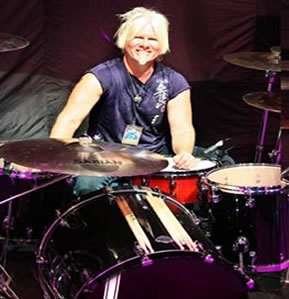
One perfect example of one such artist is producer/songwriter/composer, Tommy
McWilliams.
Having grown up in Miami, the Latin music capital of
the US, it was only a matter of time before a then promising young studio
musician would catch the attention of Emilio Estefan in the early 1980s.
The two worked closely together to help navigate a major Latin music
crossover into non-Hispanic demographics.
From there, Tommy’s career expanded. Over the next
several decades, he worked with artists such as Gloria Estefan, Jon Secada,
Lindsey Lohan, Carlos Vives, Carlos Ponce, Jaci Velasquez, Victor Manuelle,
Los Rabanes, Monica Naranjo, Ainoha, Gio, and Chayanne.
In addition to
multiple Grammy nominations and an Emmy for composing, Tommy has served
on the Board Of Governors for the Florida chapter of the National Academy
Of Recording Arts and Sciences. His record currently boasts twenty-five
RIAA certified gold and platinum albums both in the US and internationally. |
We recently got some one-on-one time with Tommy to discuss
the evolution of the music industry, the inescapability of Justin Bieber
and his ilk, and how it’s all going to be just fine.
Where do you live?
Miami, born in 1957 and raised here. There was always a lot of interesting
work to do in Miami, so I never really left. Well, I was on the road for the
majority of my early years, worked for Gloria and Emilio Estefan for 18 years,
and was the musical manager and drummer for Jon Secada, so I traveled a lot.
How did you get involved with that scene?
I think Emilio like that I had the ability to delineate
between Latin music and American music, that’s what my job was all about. Mix rich Latin
history with American sensibilities and turn it into a viable music form, that’s
what Emilio was trying to do. In my opinion, he’s the guy who did it
the best.
Muzooka has drawn several people from Miami crossover scene, which is maybe
not a coincidence.
What happened then is similar to what Muzooka is trying to do now: a marriage
of tried-and-true industry principles and practices being married with the
new digitization of music. Those are two worlds that have to merge together,
so maybe people who were around during similar world clashing music moments
are drawn to that again. We were blazing new trails, and having the ability
to see what can potentially be means hopefully find strategies to find how
to get to where we need to be.
What kind of projects are you now working on?
I’m currently involved with making music for a lot of advertising stuff,
for websites and gaming. It sounds boring but it’s a really exciting
world.
What makes you want to be involved with Muzooka?
|
What I like about Muzooka is
that it makes a distinction between the artist and the listener and
the industry person, because nowadays those lines really get blurred,
and the artists have to be concerned with industry matters because
they are their own team. Muzooka merging those three elements is as
exciting as something like bringing Latin music to the US back in the
80s.
We can talk all day long about these new artists and what they
need to be doing, and all the things they should be concerning themselves
with, but honestly, we in the industry stand to learn as much from
them as they do from us, because it’s a whole
new world in the music business. There’s a lot of opportunity to
figure out how to make it work for everyone.
That’s the big unanswered question in this whole Muzooka “experiment”:
People used to have really well-defined roles in the process of artist
discovery, and delivering music to listeners, but now the process is completely
different. Listeners are circumventing so many layers of industry people
and discovering artists on their own, and artists are doing the same by
recording and producing their own music, serving as their own PR people,
and booking agents, and managers. So now all these people with all this
experience and knowledge in the industry are often being cut out of the
process. A lot gets lost in that. |
Yeah, there’s a lot to be said for traditional roles, and more classic
division of labor in the industry, and those things can be applied to the new
technologies and ways of discovering a making music. But I don’t think
anyone has quite figured out how that works. How, say, an A&R person fits
into a world where listeners can go online and discover their new favorite
band without that band needing to be “discovered” in a traditional
sense.
It seems like people whose roles are more technical – like you as a
musician with a ton of studio experience – translate into the modern
industry configuration more seamlessly.
You can make it easier and cheaper by having the skills
and knowledge for someone to say, “I want it to sound like this”, and you are able
to make that happen. That’s the kind of skill that you can only have
after acquiring lots of experience. That’s the one thing that you have
that’s of real value, because it saves artists from wasting time.
It seems like you’re really enthusiastic and comfortable with how the
music business has evolved since you’ve been involved with it.
People are always going to complain about, be afraid,
of change. But all those old fuckers in the industry who are whining about
everything changing, I say to them, “Hey, you remember the 70s? Remember 1975 and everything changed?
It’s the same shit.” These kids are going to figure out how to
do it, how to…not direct…but to give them the benefit of our
knowledge, and to figure out what’s relevant and impart it to them in
a way that they don’t feel like they’re being preached to, and
definitely not to be angry that things aren’t the way they used to be.
You mentioned that the important things
in music haven’t
really changed.
They haven’t. It’s always been the same thing – you have
to have a great song. That’s my one piece of advice I give to everyone.
You have to be connecting with people, and that sounds cliché, but it’s
always true. And figuring out what a great song is, and bringing that out of
an artist, that’s what people like me do, and giving them an environment
to do that, that’s what we do. They have to make a genuine statement,
and even the most talented artists don’t always know that they can’t
skip that, and how to do it.
I think more and more, new artists are going to see the benefit of going back
to basics, and using people like you as great resources who can help use old
school techniques to set themselves apart from the ever-growing sea of white
noise being produced right now. These DIY artists have the same limited set
of technical skills, so their music sounds a lot the same. The smart new artists
are going to start reach out to people like you who have a much deeper range
of recording skills to give their music a distinct richness.
Sure, anyone can be an artist these days. My teenage
son has GarageBand and ProTools on his computer. Sometimes it works, doing
it on your own. But all the music that I grew up loving, it was great not
just because of the songs being well-written but because during the development
process, someone was there pushing them, telling them they can do more, do
better. The labels used to be responsible for that, but now, no one is. And
I’m not saying that
artists writing and recording and doing it all themselves can’t work.
It totally works sometimes. You know that guy Gotye?Yeah, I think I’ve
heard of him *eye roll*
Take someone like him. His album makes me feel differently
about life, every time I hear it. That’s what music is supposed to do, that’s what
it’s always going to be able to do. It’s authentic. Not only is
he a fantastic singer, but it’s so unique sounding. There’s magic
in that. And there are constantly people creating great stuff. I mean, there’s
a lot of mediocre stuff too, people trying to figure it out, and that’s
okay too. You just have to have a story to tell. Look at any of the great ones
now, even Justin Bieber who everyone hates. He’s connecting with a huge
segment of the population. I don’t like that stuff, but it was the Monkees
when I was a kid…it always happens.
People like Justin Bieber and the Monkees, or any little
teeny bopper dreamboat, they actually represent a really important step because
for teens and preteens: those people are the first time that most young people
really learn how to have an emotional connection for music. It’s a hormonal thing, and a
sexual thing, and it seems really stupid when you’ve moved beyond it,
but it’s the first intense connection most people feel for any music.
We move on and feel different things later in life, but that’s the first
big one. For a 14-year-old girl, if you’re not tapping into that part
of her, you’re not getting her attention. And 14-year-old girls spend
money, they drive a huge chunk of the industry. And that’s why people
like Bieber will always do well, even if he makes the rest of us want to claw
our faces off.
That’s a very true observation, a smart way to
look at it. And it happens in movies too. When I was young, I had this reaction
to music in movies I loved and it was only really evocative because it was
tied to these amazing visuals or story or whatever.
How do you translate those essential components to the work you do in music
today?
Well, Muzooka is a big part of that, or could be. Muzooka’s ability
to navigate through all this stuff is going to be driven by the industry pros.
It’s our job to communicate this to new musicians. The same thing was
done for me when I was young, and all I can do is reciprocate now that I have
years of experience. I’m so excited about doing it because I can almost
see how it’s going to work, and Muzooka provides the forum for all these
people to find each other, and learn from each other, and to let all this happen. |