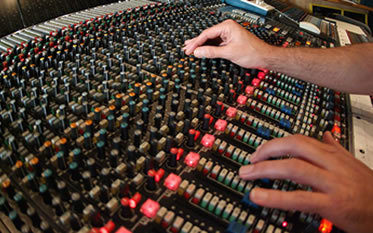
Until just a few years ago, I had no experience in doing
live sound other than tweaking my own band's PA system on
gigs.
My "baptism by fire" into the world of live sound engineering
came by way of a Sunday morning church gig, where I had to
mix both mains and monitors for 5 singers and 6 musicians
in a rectangular 40 X 100 foot 'store-front' space with no
acoustical treatment whatsoever. And I had to do all
this from a corner in the room - the absolute worst
place of all to have to mix sound.
My "board" was
an old Mackie 24X8 with no meters, and only 4 submix
busses for monitors (thank God...dealing with any
more monitor mixes would have killed me). The
singers' mics were all wireless which meant battery
changes for each before every service. I had
to deal with mic lines that ran 60 - 70 feet and
were stepped on continuously. The main speakers
were those horrendous Yamaha 2-way things with horns. The
main stage was poorly constructed and the mechanical
transmission into the mic stands from foot-stomping
and the low end feedback from the monitor wedges
drove me nuts...all while 11 different people all
at the same time were asking for "more this...more
that" in their monitors.
Somehow I survived it all, mostly I believe, by being
tactful, using common sense, and always remembering
what the gig was all about in the first place...which
brings me to the point. |
|
The soundman's gig is to present
by means of a proper balance, a representation of what
the talent on stage is trying to convey. And I
think most would agree that 99% of all performing groups
or entities are of a vocal nature where the most important
element is the vocalist(s). Why
then do soundmen begin every sound check with...the kick
drum? And why is it that at every live performance
I hear at a club or on You-Tube, the kick drum is so loud
that it drowns out everything? I remember Firefall's
first gig as a new band in 1983 at the Boulder Theater
and the afternoon sound check, where the soundman spent
over an hour trying to get 'his kick drum sound'. When
he was finally satisfied, the kick sounded like a 20 foot
parade drum - all before a single vocal or guitar mic was
opened up. Needless to say, I ultimately had to
step in and then become the soundman's least favorite person
in the group.
And if that's not bad enough, what is it with the ten dancing
fingers? I guess some soundmen feel like they're
not doing their job (or impressing any observers) if they're
not continuously moving every fader on the board every
second of the show.
No "soundman" out front doing
the mixing
Several years ago,
I did a concert with a friend of mine and my brother at
a 300 seat outdoor venue. We set
the sound up ourselves using my friends' modest collection
of gear; four EV cabs, two monitors, a couple of powered
mixers, and a modest collection of dynamic mics. We
dedicated one separate system to drums and bass, and the
other to just vocals and acoustic guitar. We balanced
the system ourselves at the afternoon sound check with me
walking around the 'house' and calling for adjustments on
stage where the mixers were located. After the show,
we had many compliments on the sound mix. One guy in
particular simply could not believe that there was no "soundman" out
front doing the mixing.
 |
We
simply got a good 'static' balance and then, in
the tried-and-true old showbiz fashion, we used
dynamics. Backround singers
backed up from the mics, and lead singers stepped
forward. Soloists turned up for their solos
and turned down when they were finished. What
a concept!
I don't mean to go on a bash here, but it seems to
me that an awful lot of people have gotten into the
sound reinforcement business for all the wrong reasons. Some
might be frustrated wanna-be musicians. But the worst are the folks who
by virtue of their ability to go out and spend thousands of dollars on equipment,
somehow assume all the qualifications to operate such. Which is about as
dumb as the guy who has never ridden before that goes out and buys the 180 horsepower
motorcycle and kills himself a day later. These soundguys "kill" the show
and half the people in the audience, trying to prove how powerful their system
is. And God help you if you try to tell them
anything, or ask why the graphic EQ's look like a map
of the Rocky Mts or the drum overhead mics are 15 feet
in the air and two inches apart! |
To end the rant, I'll share my most pleasant experiences
as a performer. Firefall did a 3 week tour with the
Beach Boys as opening act, playing a variety of outdoor
venues. And every single time we went out on stage,
the sound was absolutely perfect. The monitor mixes
were to die for.....perfect vocal balance, and acoustic
guitars that we could actually hear. And every single
night it was exactly the same. These soundguys knew
their gig; making it sound right and making the performers
happy.
On the tech-ier side, I would like
to share my theories and beliefs. First, improper use of overhead microphones
on drums in a live situation will kill the sound quicker
than anything else. I personally do not use overheads
at all. With toms, kick, hat, and snare close-mic'd,
there's really no need for them. The crash cymbals
get into everything anyway. If the drummer insists,
I get down as close as I can with a cymbal mic or two and
then roll everything out of those mics below 1500 Hz. Nothing
screws up the bass sound worse than bass bleed into other
mics, especially those stupid overheads 10 feet in the
air!!
Next, any use of compression or limiting at all in a live
situation must be done with extreme caution. I use
only absolute peak limiting to protect the amps and speakers. Compression
on vocals will only ultimately result in a lower threshhold-before-feedback
and frustrate the piss out of the singers.
And finally, if you see a graphic equalizer with any two
adjacent faders more than a half inch apart, there is something
seriously wrong with the system. This is the most mis-used
piece of equipment in the rack and probably does more damage
to the audio signal than any other component in the chain. A
properly crossed over and balanced three or four way system
should need very little if any correction. Monitors
are somewhat more critical, and a good graphic can be used
to tune out those particularly annoying feedback frequencies.
I begin by playing my favorite references like Steely's "Aja" through
the system and adjusting the low, mid, and high drivers accordingly. Crossover
points may need a tweak or two. If there are any bad "bumps" in
the room, then I'll attempt to attenuate those with proper
selection of frequencies on the graphic EQ. With group
on stage, the first mics opened will be the vocalists'. With
4 or 5 vocal mics open, you're already going to have a buttload
of guitar and drum leakage. From here, you add necessary
amounts of the drum elements to taste. if you're lucky,
your guitar players and bass player will know enough not
to "go to eleven". Keyboard players usually go direct,
so they need their own monitors cranked up good and loud
to overcome the guitars, and to keep them from pushing
up their own volume into the house.
Happy mixing!