|

By
Steve Weiss
This month I offer insight into the differences
between analog and digital audio.Most musicians nowadays own
a mix of analog and digital equipment. The terms analog and digital
have become marketing buzzwords and discussions over which is
better is a common occurrence. But I find if I ask people to
explain to me the difference between analog and digital most
of them really can't do it. There are times when one is a better
choice than the other and knowledge of how they operate will
help you make a better decision.
ANALOG
Time was when analog was
our only choice. From the time of Alexander Graham Bell's
invention of the Telephone, Marconi's Radio, Lee Dee Forest's
Vacuum Tube and Thomas Edison's Phonograph up to very recent
times, all audio was analog.
Analog is -well- an analogy. It is a reproduction of an
audio event captured in an analogous way. It can be a
recording or an amplification of the event.
But its basic
concept is that while the event is happening it is recorded
or amplified in a continuous and unbroken fashion on
or through another medium. |
 |
We will look at how this is done, but first let's define an
audio event. Anything that makes sound is creating waves through
a medium.The simplest form of this is when you listen to a sound
with your ears. Whatever is creating the sound creates a wave
that is transmitted through a medium, in this case air. These
waves strike our eardrums which resonate in sympathy with the
wave and our brain processes this as sound. To record or amplify
this event in an analog fashion it must be done in a way that
preserves these waves in a similar fashion. We will also need
separate analog processes to capture, preserve and replay the
event.
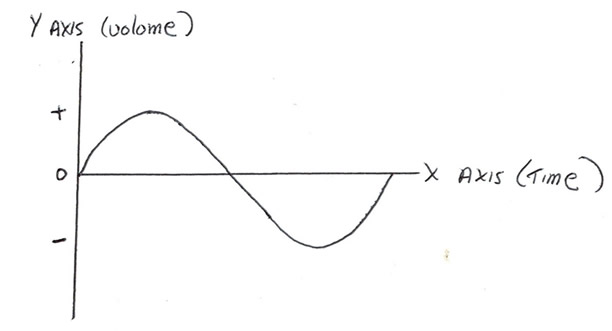
An easy way to visualize audio is to look at it graphically.
Sound has two major components, amplitude (volume) and frequency
(time). Human hearing can process waveforms up to approximately
20,000 cycles (now called Hertz or Hz) per second. So if we
think of this in the form of a graph the Y axis represents
amplitude (volume) and the X axis frequency (time). In the
accompanying diagram (fig. 1) we have represented one cycle
of sound. This could be one cycle of any frequency. What we
see is that it starts at zero amplitude goes up to a certain
positive point where it turns around and goes back to zero
and then crosses the zero line and goes to the opposite equal
negative point finally coming back to the zero point before
repeating itself as many times as per second as its frequency
dictates. The waveform pictured here is called a sine wave.
What we want to show here is that sound is a varying process
over time.Any sound will have two equal and opposite points
during each cycle. This is how your ear hears and how a speaker
moves. For example, during any cycle of sound a speaker starts
at the center of its excursion moves forward turns around crosses
through the center of its excursion and then backwards to an
equal and opposite point of its forward excursion. At any point
during the graph of this waveform if we are going to record
or amplify it we will need to be able to follow it as accurately
as possible over time.
Let's break down the analog process from input to replay:
Capturing the event:
In order to record or amplify something, there first must be
a way of capturing the audio and converting it to an electronic
form for further processing. For sound waves in the air we
use a microphone. Microphones come in a variety of flavors,
dynamic, ribbon, capacitor, etc., but they all are similar
in what they do. The microphone cartridge is placed in the
desired sound field and its microphone element vibrates in
sympathy with the audio wave, much like our ear drum. The microphone
cartridge then converts the sound wave into a voltage that
varies in step with the vibrations received by the microphone
element. Each type of microphone does this a little differently,
but let's use dynamic microphone such as a Shure SM58 as an
example. The dynamic microphone element has a diaphragm that
is attached to a coil of wire. This coil of wire is suspended
in a circular gap in a magnet. As the diaphragm moves back
in forth inside this magnetic gap a voltage is induced in the
coil from the magnetic field. This voltage will vary in step
in regards to the amplitude and frequency of the sound wave
striking the diaphragm. This voltage can now be output to our
next stage of processing.
Alternatively, if the sound we want to input is already in electronic
form as from an electric guitar or keyboard we can directly inject
it into the amplifier or recorder input.
Recording
We now can take our varying voltage from the microphone and do
something with it. If we want to record it (analog of course)
we need to put it somewhere to store for later playback. This
has been traditionally done on some sort of tape medium which
later could be transferred to vinyl. But how does the audio get
put on the tape? The simple answer to this to serve getting our
concept across is that the signal is output to a magnetic tape
head. The analog voltage of what you want to record appears at
the tiny magnetic gap on the tape head. As the tape is passed
in front of the head this tiny voltage will magnetize the magnetic
particles embedded in the coating on the tape and they will line
up in a way that varies with the voltage in the tape head's magnetic
gap. To replay the audio the tape is passed over a playback head
and the magnetic particles on the tape causes a voltage to be
induced inside the playback head that varies in step with what
is on the tape. We now have a similar voltage waveform to what
was originally stored on the tape to play back whenever we like.
Vinyl records are created by using al cutting head that vibrates
in sympathy with the input signal and cuts a groove in the record
that follows the vibrations of the cutting head. To play this
back a needle attached to a cartridge rides the groove of the
record and vibrates in sympathy with the groove. The vibrations
of the needle are converted inside the cartridge to a voltage
by either a magnetic coil or a crystal that will output a voltage
when the crystal is compressed by the vibrations of the needle.
Amplifying
We can now take our analog signal and amplify it into a form
we can hear. Obviously we want to be able to listen back through
speakers or headphones but the voltage output from a microphone
or tape head is too small to drive a speaker. Therefore we
need an amplifier. An amplifier can take the tiny voltage and
increase it to the point where it can drive a speaker system.
It does this by running the audio signal through successive
stages of amplification where the input voltage to each stage
controls a larger voltage on the output of the stage that moves
in step with it in an analog fashion. This is done several
times until there is enough voltage and current increase to
drive a speaker.
Speakers
Once the audio has been amplified we now have a larger version
of the original waveform that came out of our microphone's
output. When it is input into a speaker something happens that
is very similar to what happened inside the microphone. Where
as in the microphone when the sound wave causes the diaphragm
coil to move inside the magnetic gap and induce a voltage in
the coil we have just the opposite here. If you inject a voltage
into a coil of wire suspended in a magnetic gap the variations
in the voltage will push against the magnetic field and cause
the coil to move. If we attach this coil to a large paper cone
it will move in step with the coil and create sound.
Now we have demonstrated a complete analog system from input
through storage and playback to amplification and playback through
speakers. Analog has good points and bad points. It is easily
subject to distortion of both amplitude and frequency and it
is subject to limited dynamic range, noise and hiss. Its storage
mediums are volatile and degradable. Tape will lose its magnetic
properties over time and vinyl wears out a little every time
it is used. There is degradation of the signal every time a copy
is made. So if you are making a copy of a recording and not from
its original master tape you are subject to two generations of
degradation. On the plus side analog has pleasing characteristics
when distorted subtly. The compression of analog tape as it reaches
its saturation point is a well known and loved attribute especially
when recording drums. In general there is a perceived warmth
and realness to an analog recording when its quality is high
enough that its other imperfections do not mask it.
Digital audio
Digital audio is a modern development. Before we discuss its
pros and cons let's see how it works. First off there is no
digital way to capture sound from the air so we still need
a microphone. The input to any digital audio system is analog
with a few exceptions we will leave out for the sake of clarity
in our discussion. After the microphone we need to convert
our analog input to digital. This is done through a process
called analog to digital conversion. The analog audio at this
point is broken up into sections and whatever is happening
at a given point is given a numeric value. Think of the sine
wave from our earlier discussion. We can divide the X axis
(time) into segments. For example, If we were to divide a single
cycle of sound into ten equal parts and assign a numeric value(sample)
to the amplitude to each one, we now have a numeric representation
of the analog waveform which can be reconstructed for playback
later. Obviously if we take only ten recordings of the waveform
which is changing in a continuous fashion we are going to miss
what is happening in between those sampling points, so when
we reconstruct the waveform it will not sound very close to
the original. This means that to have a faithful reproduction
of the analog event we must sample it many times per cycle
As a matter of fact the sample rate needs to be twice the highest
frequency you will record. Therefore if you are recording as
high as a frequency of 20000 HZ, your sample rate needs to
be at least 40000 HZ. This is just like video or film. The
faster the refresh or frame rate the more accurate the image
is.
The other parameter that affects the quality of digital sound
is bit depth. If you need to assign a numeric value to an event
you would get more accuracy if you were to use a scale of 1-1000
as opposed to 1-10. in the first way you have 10000 potential
values to assign the event to, which is more accurate than 10.
Digital audio is represented in binary notation. The reason for
this is that you only get two numeric choices in binary one and
zero (on or off). It seems much less convenient than our everyday
base 10 notation that gives us a choice for each single digit
of 0-9 so we can easily represent large numbers with only a few
digits. But a computer thinks differently than we do. It uses
transistors to operate and a transistor can only be on or off,
so using binary lets us control the transistors easily. The number
strings are longer, but the computer doesn't care. For example
the base 10 number 128 becomes 10000000 in binary code. Each
digit is called a bit and since their are eight, this is an eight
bit number. Computer systems nowadays are running on sixty four
bit numbers so I'm sure you can see the possibilities of processing
audio or data at those bit depths.
Once we have recorded the digital audio
we can now decide what to do with it. Here is where the beauty
of digital audio lies. We can store it on a hard drive and
make as many copies of it as we want with no degradation at
all. Since it is data, we can stream or email it. We can record
it on a chip as a sample and put it inside a keyboard and play
back a sample of any instrument or sound by playing the keyboard.
We can run it through a digital sound processing (DSP) chip
and manipulate the sound shifting its pitch, adding delay etc.And
of course in digital recording we can slice and dice the audio
and move pieces of it anywhere we want with the click of a
mouse. All of this can be done without altering, distorting
or adding noise or hiss to the original digital recording as
would happen when this is done in analog. Remember the sound
is represented numerically by numbers. As long as the original
sequence of numbers exist nothing can vary. This also applies
to storage of the audio. Obviously unless it is seriously abused
a CD or DVD will not degrade. Yes I know a hard drive can fail
losing all its data but since you can make as many backups
as you want that sound identical to the original it doesn't
matter. This is a long way from what can happen to an analog
master tape. It will degrade over time and subsequent analog
copies of it are always lesser quality than the original. So
for the most part the storage and playback of digital data
is permanent and problem free, unless of course you are a DJ
using a "professional CD player", but I digress.
At some point we will want to listen to our digital recording
so it must be converted back to analog. This should be done as
late in the process as possible leaving the digital signal to
shuttle between various processors, equalizers etc in digital
form sometimes even sometimes being converted to optical data.
But at some point we must amplify it. There are really no true
digital amplifiers yet. Class D that everyone talks about is
not truly digital. Wherever the end point is in our digital audio
chain the signal is then input to a digital to analog converter
whereby the digital numbers are converted to analog audio voltages
in a similar but opposite process as to how the audio was digitized
in the beginning. At that point it is run through filtering to
smooth out a very ragged looking waveform and then sent to an
amplifier and speaker as an analog signal.
So what can we say about how digital sounds in comparison to
analog. Just as in an analog system where the quality and design
of the components influences the output, with digital it is subject
to sampling rates,quality of the converters etc. But we can say
that digital has a higher dynamic range and less noise than analog
and it is not subject to degradation of signal quality over time.
Does it sound as real and warm as super quality analog is a question
that is argued about every day. Some have tried to combine the
best of both worlds recording in analog and then converting to
digital. Many programs have also been written to add analog attributes
to digital audio.
I will not begin to venture an opinion where
I stand on whether I think analog or digital is better. My
goal is to explain the operation of both processes and their
differences. But as the world goes more and more digital its
easy to believe analog will play a smaller and smaller role
in audio,
| |
Steve Weiss is the owner and main technician
of Steve Weiss Electronics Inc. He is experienced in
the repair of analog and digital musical equipment.
This includes everything from Vintage Tube Amps and
Pro Audio equipment to Digital Keyboards There is also
a guitar repair shop staffed by some of the areas top
guitar repair techs. He is authorized for warranty
work on most major brands. Steve Weiss Electronics
is located inside of Sam Ash Music at 5460 West Sample
Road Margate, FL 33073 954-975-3390 Ext 272. Steve
has also spent 25 years on the road as a performing
guitarist and is the designer of Primal Guitar amps
that can be seen at Primal
Audio.com Steve can also be reached at stevew@metromusicmayhem.com |
|
|
| |
|
|