|
Hello again and welcome
to the first installment of Luthier’s
Corner for 2013. This month, I’d like to talk about
the various evolutions that have occurred in lutherie,
since the invention of the electric guitar almost a century
ago.
 |
For centuries, luthiers
pretty much crafted instruments that pretty much
stayed within certain parameters, and didn’t
really stretch the limits of imagination too much.
They followed the old adage of “if it ain’t
broke, don’t fix it.” That all changed
in the early 20th century when the electric guitar
was first invented. Soon after, you had new companies,
as well as stalwart ages old craftsman slapping pickups
on whatever they could in order to amplify their
instruments, in order to keep pace with the ever
increasing volumes of bigger bands, louder sound
systems, etc. Well, that was only the start.
You
also had luthiers, as well as hobbyists, that started
looking at various alternative ways to construct
guitars from materials other than “tone woods”,
or even converting household objects into guitars!
Sure, you had Adolph Rickenbacher’s “Frying
Pan” lap steel, and Leo Fender’s slab-bodied
Broadcaster, but soon after the invention of the
electric guitar pickup, you started to see guitars
made out of oil cans, cigar boxes, etc.
Now, cigar
box guitars have been around since at least the 19th
century, but in the last decade or so, I’ve
noticed a huge boon of creative efforts to turn almost
anything previously ignored into guitars! I myself
am guilty of this as well. Actually, I’m rather
proud of my recent “love affair” with
making guitars out of cigar boxes, toys, tin containers,
etc. And I suppose this is as good a place as any
to get to the real heart of this discussion. |
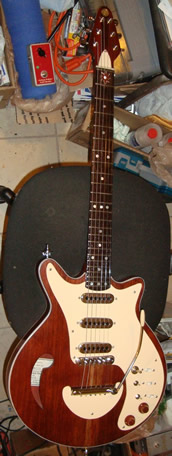 |
Never let anyone tell you that something
cannot be “converted” into a guitar.
The thing is, the same basic rules of
lutherie still apply, regardless of what you are building.
Whether it’s a “traditionally built” electric,
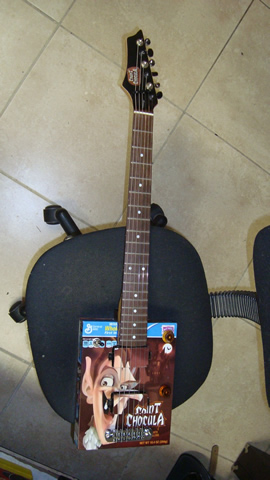
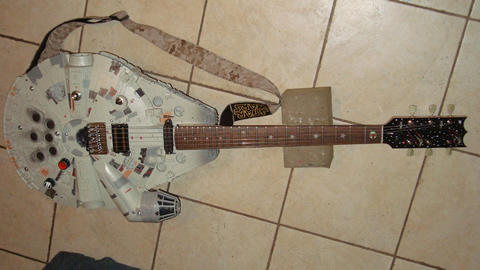
or acoustic guitar, such as the Red Special, pictured,
that I crafted in July of 2012, or a Millennium Falcon
guitar, such as the one pictured, which I built for BMI
producer, Sebastian Krys a little over a year ago, a cereal
box guitar, such as the Count Chocula guitar pictured,
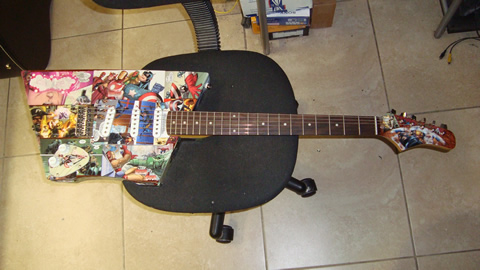
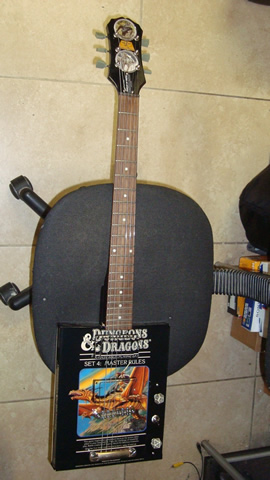
which I built just before Halloween 2012, or the Dungeons & Dragons
Box guitar, and the cigar box guitar decoupaged with Marvel
Comics guitar, both pictured, which I built just this passed
December for a couple clients in Michigan, you have to
approach these efforts remembering the same basic principles:
The guitar has to be structurally sound and durable. This
is THE most important thing. The last thing you need is
to string it up and have it snap in half, or have the bridge
collapse into the top, etc. Also, aside from making it
structurally sound, you have to make sure to keep the weight
of the entire build at under 10 lbs or so. It’s very
easy to take something like a Millennium Falcon toy ship
and want to completely reinforce the entire inside with
wood. That would be foolish, given the size of the ship
being roughly 19 inches in length, 15 inches wide, and
6 inches deep at the center! It would end up weighing around
30 pounds!
No, what you want is to reinforce just
the main center area where all the string tension occurs,
and make sure to have the reinforcement run from one end
all the way to the other. The scale length has to be correct.
Intonation has to be correct. The action has to be comfortable,
which means that the neck has to be straight, or at least
have just the right amount of relief, the frets have to
be leveled and dressed properly to prevent extraneous string
buzz, the electronics have to be of good quality, and most
importantly, the guitar has to feel, play, and sound good.
If any or all of these things fall short, then you built
a beautiful wall ornament that will not be a pleasure to
play.
There are countless things that you
could probably find, just in your home, and now, perhaps
after reading this article, will look at them and think
that they would be cool guitar build projects. Bear in
mind, just because you have an empty box of cereal sitting
on the kitchen counter, you will have to basically build
a rectangular guitar body that will glue inside the box
in order for it to be structurally sound. Once you’ve built the “body”,
or reinforced the item you plan to use as the body, it’s
time to start building the guitar. At this point, hopefully,
you already have a neck, and all the hardware and electronics
you plan to use. It makes it so much easier to draw out
all of your cutting and routing lines in the “body” if
you have all the other parts that will be mounted and/or
glued in their respective areas. The best part of building
a guitar out of an item that isn’t conventionally
thought of as a “guitar worthy” object is the
challenge. And of course, when you seethe final product,
and you plug it in for the first time, and strike that
first glorious sounding D Major chord, the feeling of accomplishment
is unmatched. And of course, building a guitar out of a
cigar box, oil can, etc, is a great way to start learning
about lutherie because it’s not as difficult as building
an entire “proper” guitar from scratch. It
really is quite an enjoyable experience, which can only
lead to you wanting to challenge yourself more by perhaps
taking on crafting a “proper” electric or acoustic
guitar from scratch.
Once again, thanks for reading my column and remember
no task worth accomplishing is ever achieved if not pursued
with fierce dedication. Believe in yourself, and make happen
that glorious noise called music! Until next time, remember,
there is nothing you can't do if you set your mind to it!
Cheers!! |