|
Each month we will be checkin what we feel is an album that
definitky may be worth revisiting. Sometimes it is easy to forget how great
some of these releases were. Many of them went on to have signifigant influence
on the music of today. When going back and checking them out again you will
often find forgotten brilliance and just maybe it will give you a new spark
of inspiration for creating something awesome on your own. (-: Thanks to Wikapedia
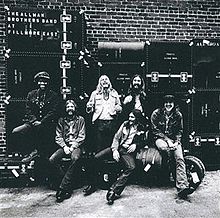
At Fillmore East is a double live album by The Allman Brothers
Band. The band's breakthrough success, At Fillmore East was released in July
1971. It ranks Number 49 among Rolling Stone magazine’s 500 Greatest
Albums of All Time[1] and remains among the top-selling albums in the band’s
catalogue. The original album was released in both conventional two-channel
stereo and four-channel quadraphonic mixes. This album has been certified as
platinum by the RIAA as of August 25, 1992
History
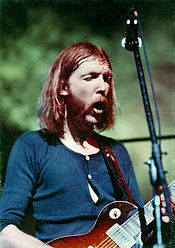
Duane Allman at Fillmore East, 1971Recorded
at the Fillmore East concert hall, the storied rock venue in New York
City, on Friday and Saturday March 12, 1971–March 13, 1971, the
album showcased the band's mixture of blues, southern rock, and jazz.
The cover of Blind Willie McTell's "Statesboro Blues" which
opens the set showcases Duane Allman's slide guitar work in open E Tuning. "Whipping
Post" became the standard for a long, epic jam that never lost interest
(opening in 11/4 time, unusual territory for a rock band), while the
ethereal-to-furious "In Memory of Elizabeth Reed", with its
harmonized melody, Latin feel, and burning drive invited comparisons
with John Coltrane (especially Duane's solo-ending pull-offs, a direct
nod to the jazz saxophonist).
The album was produced by Tom Dowd, who condensed the
running time of various songs, occasionally even merging two performances
into one track. For example, the first seven minutes of "You Don't
Love Me" is from the first show on March 12 and the rest (starting
at Duane's solo without the band) is from the second show on March 13.
At Fillmore East peaked at No. 13 on Billboard's Pop Albums chart. |
 |
The album was also specially remixed for four-channel quadraphonic
sound. In the four-channel mix Duane Allman is heard in the left rear channel,
Dickey Betts in the right rear channel, Jai Johanny Johanson in the front left
channel, Butch Trucks in the right front channel, and Gregg Allman and Berry
Oakley both centered in the front channels. The four-channel version uses some
different edits and performances of the songs taken from the same concerts.
Some of these alternate versions appeared in the 1989 compilation Dreams, although
in that release the four-channel recordings have been reduced to two-channels.
In 1998 the entire four-channel edition was reissued on CD as a 4.0 (not 5.1)
surround sound DTS disc.
Two other songs recorded during the same set of shows, "Trouble
No More" and the memorable "Mountain Jam", were later released
on Eat a Peach, the latter spanning two sides of the double album, together
with a cover of the Elmore James boogie classic "One Way Out" from
a different performance at the same venue, on June 27, 1971. The deluxe edition
of Eat a Peach includes this performance in its entirety on the second disc.
Those songs were later included in their entirety, along with
uncut versions of some, re-edited versions of others, and some previously omitted
tracks, on a new release of the Fillmore material entitled The Fillmore Concerts
(1992). "Stormy Monday" gained back a harmonica solo; "Don't
Keep Me Wonderin'" and "Drunken Hearted Boy" were included as
well.
The year 2003 saw the release of a two-disc edition entitled
At Fillmore East Deluxe Edition. It compiled all the released versions of the
Fillmore material, some material from the collection Duane Allman: An Anthology
and the Dreams box set, and remixed the material with a better soundstage than
the 1992 release. In 2004 the album was released on SACD, with stereo and surround
sound versions.
Album cover
 |
In 2003 the TV network VH1
named At Fillmore East the 59th greatest album of all time. That same
year, it was also ranked No. 49 by Rolling Stone on their list of the
500 Greatest Albums of All Time. It was one of 50 recordings chosen in
2004 by the Library of Congress to be added to the National Recording
Registry. The song "Whipping Post" is part of the The Rock
and Roll Hall of Fame's 500 Songs that Shaped Rock and Roll list.
None of the pictures of the
band for the cover were actually taken at the Fillmore East. The photographer
Jim Marshall took the cover shot near the band's headquarters in Macon,
Georgia, where the band had relocated from Florida to be near manager
Phil Walden's new Capricorn Studios.
Normally the band hated being photographed; the cover
of The Fillmore Concerts shows them displaying terminal boredom. However,
during the session, Duane spotted a dealer friend, raced over and grabbed
a bag of contraband, then returned to his seat, discreetly clutching
the stash in his lap. This cracked up all the members, resulting in a
memorable image.
The back cover shows their road crew gathered in the
same spot with 0.47 lt (16 oz.) cans of Pabst Blue Ribbon beer provided
by the photographer as a reward to the roadies for lugging out and stacking
the band's heavy equipment for the photo shoot. Their expressions certainly
seem to signify their displeasure at having to stack cases for a photo
shoot. |
At Fillmore East was well received by music critics upon its
release. George Kimball of Rolling Stone gave it a rave review and stated, "The
Allman Brothers had many fine moments at the Fillmores, and this live double
album (recorded March 12th and 13th of this year) must surely epitomize all
of them." Kimball cited the band as "the best damn rock and roll
band this country has produced in the past five years" and said of comparisons
to the Grateful Dead at the time, "The range of their material and the
more tenuous fact that they also use two drummers have led to what I suppose
are inevitable comparisons to the Dead in its better days."In his consumer
guide for The Village Voice, critic Robert Christgau gave At Fillmore East
a B– rating,indicating "a competent or mildly interesting record
that will usually feature at least three worthwhile cuts."Christgau wrote
that the songs "sure do boogie", although he ultimately found it
musically aimless, stating "even if Duane Allman plus Dickey Betts does
equal Jerry Garcia, the Dead know roads are for getting somewhere. That is,
Garcia (not to bring in John Coltrane) always takes you someplace unexpected
on a long solo. I guess the appeal here is the inevitability of it all."
In a retrospective review, Allmusic editor Stephen Thomas Erlewine
gave the album five out of five stars and stated, "[it] remains the pinnacle
of the Allmans and Southern rock at its most elastic, bluesy, and jazzy".
Mark Kemp of Rolling Stone commented that "these shows — recorded
in New York on March 12th and 13th, 1971 — remain the finest live rock
performance ever committed to vinyl", and the album "captures America's
best blues-rock band at its peak". |