|

Each month we will be featuring different
drummers and styles of music, letting them speak their mind on all aspects
of drumming, equipment, what they love about the drums, philosophies and their
reflections on music from the drummers unique perspective.
Please contact us if you would like to share your thoughts at info@MetroMusicMayhem.com.
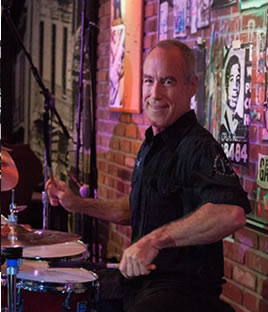
Jerry Crepeau is a drummer/percussionist teacher/producer
living and working here in South Florida since 1973. He was born
and raised in Flint, Michigan and started drumming with the school concert
band in the seventh grade. He joined marching band, drum and bugle corps,
as well as rock and funk/soul bands with fellow high school students.
Moving to Florida after graduating high school, Jerry started playing
in local bands, while also joining the Broward Symphony Orchestra and
performing musical theater. Jerry taught at The Sunrise School of Music
and The Musician’s Exchange Fame Institute and was the house drummer
there for the legendary ‘Bluesberry Jam’ from 1986-1994.
He’s played worldwide at concerts, festivals, and a wide variety
of international venues, including Rio de Janeiro, Santiago de Chile,
Budapest, Maui, Curacao, as well as television, film, radio,
and internet productions. Jerry has produced and performed on many recordings,
as well.
I’d like to share some tips and techniques
for being a well-rounded musician. One of the first things I look for in
a student (or any musician) is biomechanical bad habits such as poor
posture, improper stick control, and inefficient drum/cymbal positioning.
One mistake I often notice is uneven foot placement. When just starting
to learn the kit, the hi-hat might seem like a long reach. Many new drummers
tend to pull the stand closer to make it easier to reach, making the
feet asymmetrical, which is a disadvantage. Once the pedals are positioned
evenly, the rest of the kit should be placed to ensure maximum comfort
and efficiency. The snare drum should be about belt buckle high. I prefer
a tight and fairly low set-up. The easier it is to reach, the better. |
|
biggest mistake
One of the biggest mistakes I see is a lack of attention. In
my very first year of concert band, the conductor singled me out as the only
one in tempo, and remarked upon the fact that my visual focus on the baton
was the key to proper timing. Watching and listening to the other musicians
in the band, keeping eyes and ears open, being intentionally present, is the
only way to lock in with the other players. This will make the group sound
like a band even the first time playing together. Obviously, being prepared
and learning the material is essential.
|
Being right-handed, I like to set up
the kit on stage left whenever possible, facing the band and in line
with the other members. This allows me to see the whole band at one glance,
and allows the other players to see me without having to turn around.
The audience, on the hi-hat side, can view my hands and feet, and most
people are fascinated!
You can pick up cues on tempo, accents, and stops. It’s easy to see heads
and feet moving in time with the music, but the hands of the guitarist and keyboardist
will help guide you through unfamiliar territory and facilitate cohesive improvisation.
The bass player’s fingers will help synchronize the kick drum. Even if
you have discovered the ‘perfect’ part for the song you are playing
and wouldn’t change it, connecting with the band visually helps nail
that tight band sound.
Drummers tend to stare at the drums while playing. One method for overcoming
this is to either use a blindfold or just turn out the lights when practicing.
Relying on the sense of touch alone enhances the tactile connection with the
kit. Picture your sticks as extensions of your body and visualize your set-up
in the dark. |
When playing musical theater I had to watch for cues
from actors to play certain parts and crash the cymbals with the dancers’ kicks.
Jazz and blues music especially demands constant attention to the nuances
of the other performers’ improvisations.
Years of hosting blues jams and filling in with various groups were facilitated
by keeping my head up and listening to everything. Also essential to
being well rounded is exposing oneself to a wide variety of musical styles.
The internet and the public library, as well as radio and television, are excellent
resources for expanding your horizons and advancing your musical education. Relaxing
and enjoying the music you are playing is very important. Play with as
much enthusiasm in an empty room as you would in a packed, cheering stadium.
Remember, it’s about the music.
I have been rewarded with the opportunity to play a wide variety of styles
and genres. No matter how diverse, they all have one thing in common: the more
you listen the more you learn. I have developed my skills and earned the trust
of many bandleaders who have me on their short list.
I thank the universe!
|