|

By Linda M. Sekulic
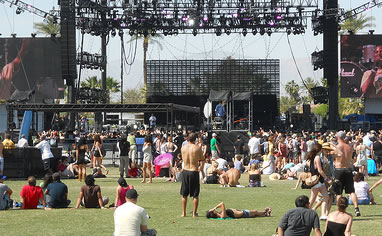
OUTDOOR FESTIVALS are
typically held outside, at a specific location, that offers several
acres of land. and ARENA SHOWS are typically held at large
inside arenas where quite often, sports events are also held.
With a Festival,
the number one issue is usually security, to keep the
crowd under control, so they don’t rush the stage, and cause a riot. Usually
public (chain link) fencing is used, to determine the closed
stage area, to protect the artists and their gear. Vandalism
is common, with outside shows. Porta-Potties are also a
necessity. Weather is a determining factor, and lighting,
rigging, P.A. equipment, etc. need to be “waterproofed,” in
order to avoid electrical shock. One of the most powerful
opportunities for a recording band, to get local exposure
is to become involved in an outdoor Festival, with a local
community based event, or perhaps a high profile benefit
show. This shows the band has regard for the general public – in
other words – their fans – and it could increase
their chances of sponsors or investors, further on down
the line. Even headlining a local “multiple band” concert
is another option, for an outdoor Festival. One setback
is food – outdoor storage and cooking facilities
are not always sanitary. In the end, proceeds can be very
rewarding, providing the organizers did their job, accordingly. |
|
If the festival location is out of town,
you have to arrange passports (if you don’t already have
one), work Visas, and all depending on where you are going,
possibly an immunization shot, as a health precaution. Traveling
without health insurance is not a good idea, when it could
cost you future concert dates, due to unexpected cancellations,
on account of extreme sickness. You may even have to deal with
a currency exchange, when traveling to another country. Laminates
(security passes) are typically made up in advance, so backstage
security and record label reps can find people, and know who
everyone is. Record industry reps get a better impression,
when a large festival is well organized, and the band has the
ability to put on a memorable show, and bands are more likely
to be re-booked for future events.
LED lighting is usually most advantageous outdoors,
for both the band and the audience.
It is harder to run a sound board, as there are no “arena
dimensions” outside, however, with a good PA, and proper
monitors, a good effects rack, and a Union sound man (you don’t
want anything less at a high profile event) you shouldn’t
have issues. Sound checks are mandatory, in order to set up the
mixing board appropriately. On occasion, a band will tape a series
of live concerts, to ultimately produce a “live” CD
for release.
Merchandise is a critical part of the “big picture” because
typically a band has to pay to join a large tour, and aside from
ticket sales, merchandise is still the best source of revenue.
Touring is extremely expensive, and one way to get funding, is
through a “brand sponsor” like Virgin Mobile, Nike,
or Labbatt’s Blue beer, for example. The more variety you
have with your merchandise, the larger your sales market will
be. Men’s and women’s items should both be available.
A lot of bands have a website, and advertise merchandise to promote
online sales. Merchandise samples are usually intended for promotion – to
music industry reps, radio stations, television stations, Universities,
venue owners, promoters, etc. It is advisable to have hoodies,
t-shirts, CD’s, Posters, Baseball hats, key chains, bumper
stickers, etc. A band should have their own logo - or trademark,
because after all, that is what “branding” is all
about. Even a “character” like Iron Maiden’s “Eddie – the
walking corpse,” or the name KISS, for example. (the letter “s” is
substituted by the letter “Z”)
Festivals are usually held in warm climate, in
summer months, when attendance is up (due to everyone being on
vacation) and traveling (by land) with very expensive gear is
not a liability factor.
LARGE INDOOR ARENAS
|
Taking place
at large scale indoor venues, (seating capacity of 30,000
or more) Arena shows allow more of an advantage, where
specialized laser light systems, can be utilized to the
fullest, and elaborate sound equipment/racks can also
be operated to maximum capacity. The insurance factor
differs also, concerning any rental gear. The liability
factor for equipment is generally lower, because it is
considered safer, indoors.
Also, when the capacity is
limited to a specific number, instead of excess numbers
of people at an outdoor event, it would also be easier
to administer First Aid, when necessary, as the situation
is more controlled. Then no one would be likely to get
sued…Parking is more convenient, with this
type of show, as parking lots are generally part of the
grounds of Large arenas, to offer convenience to commuters
attending shows. A good show will always promote future
bookings too, as it boosts food/beer sales for the venue.
At an indoor, large Arena type of venue, you would not
have to worry about a liquor license, as the venue would
already have one.
|
Stage production is an integral part of
indoor shows, especially where drum risers, and moving (mechanical)
stage components, lighting rigs, concert PA gear and digital
mixing board, accompanying backdrop videos, props, stage make
up, costumes, and even masks are involved as part of the show.
A fleet of large trucks is usually required to transport this
type of gear. Special effects like pyro, and dry ice are used
in “moderation” due
to fire regulations. These things all add up to “dynamics,” and
a good stage show always promotes future ticket and CD sales.
Appearance dates are always confirmed in advance, so as to avoid
any liabilities or “double-bookings” and usually
the business papers, or contracts, are signed by the Band Manager,
Promoter, Record Label (if the band is signed to one) and the
Individual who handles the rental fee, for the Arena.
If a band has legal permission to film
their own concert, with their own crew, they can take advantage
of that, by releasing a “live”performance video for marketing. Not all
fans can physically attend a show, perhaps it sold out quickly,
or the headlining act became too sick to perform, and had to
cancel, so this way, they can purchase “the band’s
live performance video,” as an alternate option.
Indoor Arena shows can be held anytime
of year, so clearly, there is an obvious advantage, as this
is not a limited “seasonal” thing
like Outdoor Festivals. Certain district noise bylaws can become
very “inconvenient” if event arrangements do not
include consideration of this.
In closing, there are choices out there,
and either your record label, band manager, and or promoter
will know best how to advise you, unless you are already at
the professional level, and have done promotional/international “New CD Release” tours,
and ultimately, world tours.
Linda has been a musician for
over 40 years playing several instruments, including bass, guitar,
drums, vocals,
For over 16 years she has working in the field of Entertainment
Law and is the President of an
Independent Record Label for over 20 years. Formerly listed
in the Who's Who Music Directory, then listed annually, in Music
BC's Business directory, her largest business deal to date:
a distribution deal (with Spinner Distribution) involving 20
bands that were unsigned, and had no existing management for
a compilation CD to market in Europe.
Volunteer for the New Music West Festival, and Music BC (formerly
the Pacific Music Industry Association)
Linda M. Sekulic is the
Owner/President POP RECORDS INC
She can be reached for
inquiries at linda_sekulic@yahoo.ca
|