|
This month begins a several part discussion
of speakers. Speakers come in an astonishing variety of
sizes, wattages,cone styles and impedances. A speaker can
be considered both an electronic and mechanical device
so there are a lot of ways for speakers to be different
from each other. This month we will look at how a speaker
operates and the influence imparted on its sound by the
enclosure it is put in. Then we will move on to the practical
application of speakers in guitar, bass amps and sound
systems. Let's look at how a speaker works:
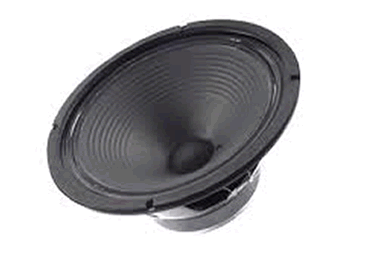
First, a list of the physical components in a conventional
speaker:
-
FRAME - A metal structure which the other speaker components
are mounted too. Usually made of stamped metal or cast
metal in the more professional speakers.
-
CONE - Generally made from paper, this
is the part of the speaker that does the work of pushing
air and creating sound.
-
VOICE COIL - A coil of wire wound around
a former and attached to the narrow part of the cone.
-
MAGNET - Attached to the rear of the frame
has a circular gap on its front that the voice coil sits
in.
-
SURROUND - A flexible ring of material that connects
the outside edge of the cone to the speaker frame. This
allows the cone flexibility to move without eventually
ripping (at least under normal conditions).
-
SPIDER - A flexible disc located at the junction of
the cone and voice coil that attaches the back of the
cone to the frame. Similar in function to the surround
it allows movement of the cone.
-
DUST CAP - A circular disc that covers the opening in
the center of the cone. Serves to keep dirt from getting
into the gap between the magnet and voice coil .
-
TERMINALS - This is where the two wires coming from
the voice coil are attached. Connecting output wires
from an amplifier here let the audio signal flow into
the voice coil.
Now let's describe how a speaker operates:
The main thing to understand
here is how the movement of the cone is created.
As we said above there is a coil of wire positioned
inside a circular gap in the magnet. When an audio
signal is input to a coil it creates a magnetic field
around the coil. I am sure you remember as a child
hooking a dry cell battery to a wire coiled around
a nail. This caused the nail to become magnetic and
created an electromagnet. In the speaker's case,
the alternating polarity magnetic field created by
the coil pushes and pulls against the magnet's field
causing the coil to move.
Since the voice coil is
attached to the cone it also is set in motion pushing
air. The opposite effect is also true. If you physically
move the cone and voice coil inside the magnet's
field a voltage will be induced and output from the
coil. This is how a dynamic microphone works. When
sounds waves strike a microphone's diaphragm it moves
the coil attached to it creating a voltage that is
analogous to the
mechanical movement of the coil. |
|
Getting back to the speaker's operation, two more things
are needed. It is essential that the cone and voice coil
be aligned in the magnetic gap for proper operation. First,
the coil must be aligned so it is centered in the gap and
not able to make contact with the magnet. If it does touch
it will restrict the cones movement causing distortion
and possibly lead to the failure of the voice coil due
to rubbing which could eventually wear through the voice
coil wires, causing it to fail.
Secondly, the cone must sit in the magnetic gap so it
has the ability to move an equal amount forward or back
with no restriction. An audio signal is an alternating
voltage (A/C) that can be any frequency between 20 cycles
per second, called 20 HZ (Hertz) or 20,000 HZ. Bass notes
are in the lower frequency range and high notes the upper
frequency range. It doesn't matter how many cycles a signal
has, each individual cycle of it has two halves, a positive
and a negative component. This means that at the start
of any cycle the signal will increase from zero to a specific
point (peak value) and then decrease back to zero. It will
then do the same exact thing but in an opposite fashion
to a negative peak and then return to zero completing one
cycle of sound. If we were to assign numeric values to
this for the sake of explanation here, let's say the cycle
starts at zero volts increase to 10 volts and then back
to zero. This is followed by the signal going to -10 volts
and then back to zero. If this does not happen in exactly
this fashion where either half of the wave is not the same
as the other then distortion is introduced. Remember this,
we will get back to that concept. Remember also that the
dynamics of a signal are created by the amount of voltage.
A 10 volt signal will be louder than a five volt signal.
So as the audio signal varies in strength (amplitude) we
can hear changes in its loudness.
As I said above it is necessary to have the ability to
produce both sides of the waveform equally. Mechanically
the voice coil must be positioned in the magnetic gap so
it can move back and forth an equal amount. Conventionally
a speaker voice coil is wired so the positive part of the
waveform pushes the cone out and the negative waveform
pulls it in towards the magnet. Therefore if the coil is
positioned too low in the gap it may bottom out on the
magnet on louder signals causing distortion of the signal
and maybe damaging the coil physically by smashing it into
the magnet. If the coil is positioned too far forward in
the gap, the cones movement will be restricted by ability
of the surround and spider to flex, also creating distortion
or ripping the surround. Positioning the coil too far forward
in the gap can also pull the coil out of the gap and change
its interaction with the magnetic field possibly dropping
the speakers impedance and causing it to overheat.
It should go without saying that even if the coil is positioned
perfectly in the magnetic gap that overdriving the speaker
with a signal that is larger than what the speaker is rated
for can cause any of the above failure modes to happen.
ENCLOSURES
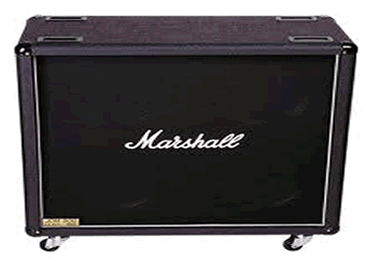 |
Now that we understand
how a speaker works there is one more part of the
speaker equation to discuss. A raw speaker by itself
will not sound very good. You can pump as much power
as you want into it and crank up the bass on your
EQ but it will still sound thin. What is the reason
for this? The explanation is simple. The speaker
is pushing and pulling air as it operates. But since
there is nothing to prevent the wave created by the
forward motion from mixing with the rear wave, the
two opposite phase wave forms mix together and cancel
each other out.
This is truer of the lower frequencies
because they are not very directional and propagate
pretty well everywhere. The higher frequencies tend
to be more directional so there is less interaction
between the front and rear waves. This is why the
speaker sounds thin because more of the bass is canceled
than the highs. So how do we get around this problem?
The answer is to prevent the front and rear waves
from cancelling each other. In the early days, the
first speakers were installed in theaters as talking
pictures came into fashion. Here, since it was a
permanent installation all that was needed to be
done was cut a hole in the wall and mount the speaker. |
The front of the cone radiated sound
out into the theater and the rear wave was lost behind
the wall in another room unable to cancel the front wave.
A good solution, but if you needed portability carrying
an entire building with you was not a practical answer
to the problem. Therefore it was realized that you could
take the wall the speaker was mounted to and fold it around
the speaker into a box. This would contain the rear wave
within the box preventing cancellation. Now you could carry
your speaker system with you to use where you like. It
was then soon discovered that varying the box dimensions
and a few other things could influence both the tone and
efficiency of the sound produced. As time went on three
types of enclosures were developed that are still in use
today.
INFINITE BAFFLE (sealed box)
A sealed box needs a minimum air volume inside it or
the buildup of air pressure when compressed by the rear
motion of the cone limits its ability to move as far as
needed, distorting the waveform. Also due to reflections
of the waveform inside the cabinet the possibility of standing
waves being created exists. This can cause cancellation
of the wave at certain lower frequencies. This is usually
alleviated by putting some damping material such as fiberglass
to mitigate the reflections.
BASS REFLEX (ported)
It was later discovered that cutting a hole of a specific
size into the box had the effect of bringing the speaker's
low frequency rear wave out of the box in phase so it reinforces
instead of canceling the front wave. Also, venting the
air inside the cabinet out the port reduces the possibility
of cone restriction from air compression inside the cabinet.
The theory behind this was discovered by A.N. Thiele and
Richard N. Small in the sixties and it enabled enclosures
and speakers to be designed with very predictable frequency
response results. By using their research a port can be
constructed by cutting a hole in the front of the cabinet
and mounting a tube behind it. The length and diameter
of the tube can be calculated according to the speaker
being used and the size of the enclosure. These are usually
referred to as bass reflex enclosures or Thiele enclosures.
Their are many pros and cons to both a closed box or ported
box that to discuss is beyond the scope of this article.
But in general terms if a lift to the low frequency response
is desired, a ported cabinet is a good solution.
HORN
One more popular type of cabinet
is the horn enclosure. In this type of cabinet the speaker
is set back into the cabinet and in front of it is a
flared out set of panels. This is an easy concept to
explain. Let's say you need to get someone's attention
across a noisy street. You yell over but they don't hear
you. What is the next thing you do? You place one hand
on either side of your mouth as you yell again. We all
know this will make your voice louder and project it
it a more specific direction. What you have done is create
a horn in front of your mouth and benefit from the extra
projection it provides. The same effect occurs by playing
the speaker into a horn. There is also an enclosure style
called the folded horn. In this enclosure a much larger
horn flare is designed where the speaker is inside the
enclosure and fires into a horn that has been "folded" into
a smaller size but contains the same area as if it was
not folded. This gives portability with extra efficiency.
Now that you have a basic understanding of speakers and
enclosures, next month we will move on to the practical
applications of speakers and enclosures.
Steve
Weiss is the owner and main technician of Steve Weiss
Electronics Inc. He is experienced in the repair
of analog and digital musical equipment. This includes
everything from Vintage Tube Amps and Pro Audio equipment
to Digital Keyboards There is also a guitar repair
shop staffed by some of the areas top guitar repair
techs. He is authorized for warranty work on most
major brands. Steve Weiss Electronics is located
inside of Sam Ash Music at 5460 West Sample Road
Margate, FL 33073 954-975-3390 Ext 272. Steve has
also spent 25 years on the road as a performing guitarist
and is the designer of Primal Guitar amps that can
be seen at Primal
Audio.com Steve can also be reached at stevew@metromusicmayhem.com |
|
|