|
Each month we will be checkin what we feel is an album that
definitky may be worth revisiting. Sometimes it is easy to forget how great
some of these releases were. Many of them went on to have signifigant influence
on the music of today. When going back and checking them out again you will
often find forgotten brilliance and just maybe it will give you a new spark
of inspiration for creating something awesome on your own. (-: Thanks to Wikapedia
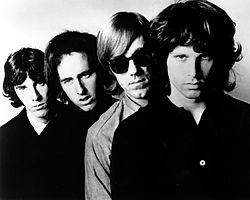
The Doors were an American rock band formed
in 1965 in Los Angeles, California, with vocalist Jim Morrison, keyboardist
Ray Manzarek, drummer John Densmore and guitarist Robby Krieger. The band
took its name from the title of Aldous Huxley's book The Doors of Perception,]
which itself was a reference to a William Blake quotation: "If the doors
of perception were cleansed every thing would appear to man as it is, infinite." They
were among the most controversial rock acts of the 1960s, due mostly to Morrison's
wild, poetic lyrics and charismatic but unpredictable stage persona. After
Morrison's death in 1971, the remaining members continued as a trio until
finally disbanding in 1973
They were signed to Elektra Records
in 1966. The 1967 release of The Doors was the first in a series of top
ten albums in the US, followed by Strange Days (1967), Waiting for the
Sun (1968), The Soft Parade (1969), Morrison Hotel (1970), Absolutely
Live (1970) and L.A. Woman (1971), with 19 Gold, 14 Platinum and 5 Multi-Platinum
album awards in the United States alone. Although The Doors' active career
ended in 1973, their popularity has persisted.
According to the RIAA,
they have sold 32.5 million certified units in the US. The band has sold
over 100 million albums worldwide. Ray Manzarek and Robby Krieger toured
as "Manzarek–Krieger" or "Ray Manzarek & Robby
Krieger of The Doors" for legal issues, performing Doors songs exclusively.
The Doors were the first American band to accumulate eight consecutive
gold LPs. In 1993, The Doors were inducted into the Rock and Roll Hall
of Fame. |
 |
History
1965–68 Origins and formation [edit]The origins
of The Doors lie in a chance meeting between acquaintances and fellow UCLA
film school alumni Jim Morrison and Ray Manzarek on Venice Beach in Los Angeles
in July 1965. Morrison told Manzarek he had been writing songs (Morrison said "I
was taking notes at a fantastic rock'n'roll concert going on in my head")
and, with Manzarek's encouragement, sang "Moonlight Drive".
Keyboardist Manzarek was in a band called
Rick & the Ravens with his brothers
Rick and Jim Manzarek, while drummer John Densmore was playing with The Psychedelic
Rangers, and knew Manzarek from meditation classes. In August, Densmore
joined the group, renamed The Doors, and the five, along with bass player Patty
Sullivan (later credited using her married name Patricia Hansen in the 1997
box CD release) recorded a six-song demo in September 1965. This has since
then circulated widely as a bootleg recording. The band took their name from
a line in Aldous Huxley's book The Doors of Perception; "If the doors
of perception were cleansed everything would appear to man as it is, infinite".
The line comes originally from William Blake's The Marriage of Heaven and Hell.
In mid 1965, after Ray Manzarek's two brothers left, the group recruited guitarist
Robby Krieger and the final lineup — Morrison, Manzarek, Krieger and
Densmore — was complete.
Whisky a Go Go
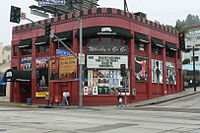 |
By 1966, the group
was playing the LA club London Fog and soon graduated to the prestigious
Whisky a Go Go, where they were the house band, supporting acts including
Van Morrison's group Them. On their last night together the two bands
joined up for "In
the Midnight Hour" and a twenty-minute jam session of Them's "Gloria".
Prior to graduating to Whisky a Go Go, Morrison went to many record labels
trying to land a deal. He did score one but it did not pan out. On August
10, they were spotted by Elektra Records president Jac Holzman who was
present at the recommendation of Love singer Arthur Lee, whose group
was with Elektra Records. After Holzman and producer Paul A. Rothchild
saw two sets of the band playing at the Whisky a Go Go, they signed them
to the Elektra Records label on August 18—the start of a long and
successful partnership with Rothchild and engineer Bruce Botnick. Later
that month, the club fired the band after a profanity-filled performance
of "The End" |
Debut album
The band recorded their first album from August 24 to
31, 1966 at Sunset Sound Recording Studios. The Doors' self-titled debut
LP was released in the first week of January 1967. It featured most of the
major songs from their set, including the nearly 12-minute musical drama "The End".
The Doors performing at Fantasy Fair and Magic Mountain Music Festival in 1967In
November 1966, Mark Abramson directed a promotional film for the lead single "Break
On Through (To the Other Side)." To promote the single, the Doors made
their television debut on a Los Angeles TV show called Boss City, circa 1966,
possibly early 1967 and then on a Los Angeles TV show called Shebang, miming
to "Break On Through," on New Year's Day 1967. This clip has never
been officially released by the Doors.
In early 1967 The Doors appeared on The Clay Cole Show
(Saturday evenings at 6 pm on WPIX Channel 11 out of NYC) where they performed
their single "Break
On Through". Research has determined that the tapes were all wiped, the
only shows that still exist are the final ones copied by an employee of the
station, unfortunately this was long after The Doors' appearance. The Doors
returned to The Clay Cole Show a second time on June 24 where they most likely
performed "Light My Fire."
Since "Break on Through" was not very successful on the radio, the
band turned to "Light My Fire". The problem with this song was that
it was seven minutes long, so producer Paul Rothchild cut it down to a three
minute song by editing out the lengthy keyboard and guitar solos in the center
section. "Light My Fire" became the first single from Elektra Records
to reach number one on the Billboard Hot 100 singles chart, selling over a
million copies. "Light My Fire" was the first song ever written
by Robby Krieger and was the beginning of the band's success.
Early live recordings at The Matrix From March 7 to March 11, 1967,
The Doors performed at the Matrix Club in San Francisco, California. The March
7 and 10 shows were recorded by a co-owner of The Matrix, Peter Abram. These
recordings are notable as they are among the earliest live recordings of the
band to circulate. On November 18, 2008, The Doors published a compilation
of these recordings, Live at the Matrix 1967, on the band's boutique Bright
Midnight Archives label.
Early television performances
The Doors appeared on American television
on August 25, 1967, guest-starring on the variety TV series, Malibu U, performing "Light
My Fire." They did not appear live. The band is seen on a beach and are
performing the song in play back. The music video did not gain any commercial
success and the performance was more or less forgotten. It was not until
they appeared on The Ed Sullivan Show that they gained attention on television.
The Doors performing for Danish television in 1968The Doors made their international
television debut in May 1967, recording a version of "The End" for
the Canadian Broadcasting Corporation (CBC) at O'Keefe Centre in Toronto.But
after its initial broadcasts, it remained unreleased except in bootleg form
until the release of The Doors Soundstage Performances DVD in 2002. As "Light My Fire" climbed
the charts in June and early July, The Doors were on the East Coast as an
opening act for Simon and Garfunkel in Forest Hills, Queens and as headliners
in a Greenwich, Connecticut, high-school auditorium.
On September 17, 1967, The Doors gave a memorable performance
of "Light
My Fire" on The Ed Sullivan Show. According to Ray Manzarek, network
executives asked that the word "higher" be removed in favor of "better." The
group initially agreed to this, but nonetheless performed the song in its original
form, either because they had never intended to comply with the request, or
Jim Morrison was nervous and forgot to make the change (Manzarek has given
conflicting accounts). Either way, "higher" was sung out on national
TV, and a furious Ed Sullivan canceled another six shows that had been planned.
After the show's producer told the band they would "never do the Ed Sullivan
show again", Jim Morrison reportedly replied: "Hey man. We just did
the Sullivan Show."
On December 24, The Doors performed "Light My Fire" and "Moonlight
Drive" live for The Jonathan Winters Show, their performance was taped
for later broadcast. From December 26 to December 28, the group played at the
Winterland Ballroom in San Francisco. An excerpt taken from Stephen Davis'
book on Jim Morrison (p. 219–220):
The next night at Winterland, a TV set was wheeled onstage
during The Doors set so the band could see themselves on The Jonathan Winters
Show. They stopped playing "Back Door Man" when their song came
on. The audience watched the Doors watching themselves on TV. They finished
the song when their bit was done, and Ray walked over and turned the TV off.
The next night was their last ever in Winterland.
They played two more dates in Denver on December 30 and December 31, 1967,
capping off a year of almost constant touring.
Strange Days
The Doors spent several weeks in Los' Angeles' Sunset
Studios recording their second album, Strange Days, experimenting with the
new technology, notably the Moog synthesizer they now had available. The
commercial success of Strange Days was middling, peaking at number three
on the Billboard album chart but quickly dropping, along with a series of
underperforming singles. The chorus from the album's single "People Are Strange" inspired
the name of the 2010 documentary of The Doors, When You're Strange.
Although session musician Larry Knechtel had been featured
on bass on several tracks on the band's debut album, Strange Days was the
first Doors album recorded with a studio musician on bass on most of the
tracks, and this continued on all subsequent studio albums. Manzarek explained
that his keyboard bass was well-suited for live situations but that it lacked
the "articulation" needed
for studio recording. Douglass Lubahn played on Strange Days and the next
two albums; but the band used several other musicians for this role, often
using more than one bassist on the same album. Kerry Magness, Leroy Vinnegar,
Harvey Brooks, Ray Neopolitan, Lonnie Mack and Jerry Scheff are credited as
bassists who worked with the band.
New Haven incident On December 9, 1967, The Doors performed
a now infamous concert at New Haven Arena in New Haven, Connecticut, which
ended abruptly when Morrison was arrested by local police.Morrison became
the first rock artist ever to be arrested onstage during a concert performance.
Morrison's mugshot taken in New HavenMorrison had been "making out" with
a fan backstage in a bathroom shower stall prior to the start of the concert
when a police officer happened upon them. Unaware that he was the lead singer
of the band about to perform, the officer told Morrison and the girl to leave,
to which Morrison said, "Eat it." The policeman took out a can of
mace and warned Morrison, "Last chance", to which Morrison replied, "Last
chance to eat it." There is some discrepancy as to what happened
next: according to No One Here Gets Out Alive, the girl ran and Morrison was
maced; but Manzarek recounts in his book that both Jim and the fan were sprayed
and that the concert was delayed for an hour while Jim recovered.
Halfway through the first set, Morrison proceeded to go on an obscenity-laced
tirade to the audience, describing what had happened backstage and taunting
the police, who were surrounding the stage. The concert was abruptly ended
when Morrison was dragged offstage by the police; he was taken to a local police
station, photographed and booked on charges of inciting a riot, indecency and
public obscenity. Charges against Morrison, as well as those against three
journalists also arrested in the incident (Mike Zwerin, Yvonne Chabrier and
Tim Page), were dropped several weeks later due to lack of evidence.
Waiting for the Sun
Recording of the group's third album
in April 1968 was marred by tension as a result of Morrison's increasing
dependence on alcohol and drugs, and the rejection of his new epic, "Celebration
of the Lizard", by band producer Paul Rothchild, who deemed the
work not commercial enough. Approaching the height of their popularity,
The Doors played a series of outdoor shows that led to frenzied scenes
between fans and police, particularly at Chicago Coliseum on May 10.
.The band began to branch out from their initial form
for this third LP. Because they had exhausted their original repertoire,
they began writing new material. Waiting for the Sun became their first
No. 1 LP, and the single "Hello, I Love You" was their second
and last US No. 1 single. With the 1968 release of "Hello, I Love
You", the rock press pointed out the song's resemblance to The Kinks'
1964 hit, "All Day and All of the Night". Kinks guitarist Dave
Davies was particularly irritated by the similarity. In concert, Morrison
was occasionally dismissive of the song, leaving the vocal chores to
Manzarek, as can be seen in the documentary The Doors are Open. |
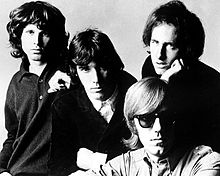 |
A month after riotous scenes took place at the Singer Bowl in New York, the
group flew to Britain for their first performance outside of North America.
They held a press conference at the ICA Gallery in London and played shows
at The Roundhouse Theatre. The results of the trip were broadcast on Granada
TV's The Doors Are Open, later released on video. They played dates in Europe,
along with Jefferson Airplane, including a show in Amsterdam where Morrison
collapsed on stage after a drug binge.
The group flew back to the US and played nine more US
dates before returning to work in November on their fourth LP. They ended
the year with a successful new single, "Touch Me" (released in
December 1968), which hit US No. 3. They started 1969 with a sold-out show
on January 24 at Madison Square Garden.
1969–71 The Soft Parade
The Doors' fourth album, The Soft
Parade, released in July 1969, contained pop-oriented arrangements and horn
sections. The lead single "Touch Me" featured saxophonist Curtis
Amy. While the band was trying to maintain their previous momentum, efforts
to expand their sound gave the album an experimental feel, causing critics
to attack their musical integrity. According to John Densmore in his biography
Riders On The Storm individual writing credits were noted for the first time
because of Morrison's reluctance to sing the lyrics of Robby Krieger's song "Tell
All the People". Morrison's drinking made him difficult and unreliable,
and the recording sessions dragged on for months. Studio costs piled up, and
The Doors came close to disintegrating. Despite all this, the album was immensely
successful, becoming the band's fourth hit album.
Miami incident
On March 1, 1969, at the Dinner Key Auditorium in the
Coconut Grove neighborhood of Miami, The Doors gave the most controversial
performance of their career, one that nearly "derailed the band".The
auditorium was a converted seaplane hangar that had no air conditioning on
that hot night, and the seats had been removed by the promoter in order to
boost ticket sales.
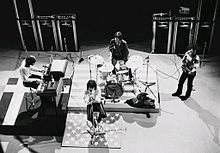
Morrison on The Smothers Brothers Comedy Hour, December 6, 1968
 |
Morrison had been
drinking all day and had missed connecting flights to Miami, and by
the time he eventually arrived the concert was over an hour late in
starting, and he was, according to Manzarek, "overly fortified with alcohol". Morrison had
recently attended a play by an experimental theater group, The Living
Theatre, and was inspired by their "antagonistic" style of
performance art. The restless crowd of 12,000, packed into a facility
designed to hold 7,000, was subjected to Morrison's lack of interest
in singing shortly into "Break On Through".Morrison taunted
the crowd with messages of both love and hate, saying, "Love me.
I can't take it no more without no good love. I want some lovin'. Ain't
nobody gonna love my ass?" and alternately, "You're all a bunch
of fuckin' idiots!" and screaming "What are you gonna do about
it?" over and over again. |
At one point, Morrison removed the hat of an onstage police officer and threw
it into the crowd; the officer, in turn, removed Morrison's hat and threw
it.Manager Bill Siddons recalled, "The gig was a bizarre, circus-like
thing, there was this guy carrying a sheep and the wildest people that I'd
ever seen".Equipment chief Vince Treanor said, "Somebody jumped
up and poured champagne on Jim so he took his shirt off, he was soaking wet.
'Let's see a little skin, let's get naked,' he said, and the audience started
taking their clothes off." Having removed his shirt, Morrison held
it in front of his groin area and started to make hand movements behind it.
Manzarek later described the incident as a mass "religious hallucination".
On March 5, the Dade County Sheriff's office issued a
warrant for Morrison's arrest claiming Morrison deliberately exposed his
penis while on stage, shouted obscenities to the crowd, simulated oral sex
on guitarist Robby Krieger and was drunk at the time of his performance.
Morrison turned down a plea bargain that required The Doors to perform a
free Miami concert. He was later convicted, sentenced to six months in jail,
with hard labor, and ordered to pay a $500 fine. Morrison remained free pending
an appeal of his conviction, and would die before the matter was legally
resolved. In 2007 Florida Governor Charlie Crist suggested the possibility
of a posthumous pardon for Morrison, which was announced as successful on
December 9, 2010. Densmore, Krieger and Manzarek have denied the allegation
that Morrison exposed himself on stage that night.
More legal problems
During the recording of their next album, in November
1969, Morrison once again found himself in trouble with the law after harassing
airline staff during a flight to Phoenix, Arizona to see The Rolling Stones
in concert. Both Morrison and his friend and traveling companion Tom Baker
were charged with "interfering with the flight of an intercontinental
aircraft and public drunkenness". If convicted of the most serious
charge, Morrison could have faced a possible ten-year federal prison sentence
for the incident. The charges were dropped in April 1970 after an airline
stewardess reversed her testimony to say she mistakenly identified Morrison
as Baker.
Aquarius Theatre performances
The Doors gave two concerts at the Aquarius
Theatre on Sunset Blvd, Hollywood. The two shows were performed on July 21,
1969. A "backstage" performance, a so-called "private rehearsal" without
an audience occurred on July 22, 1969. This was only a few months after the "Miami
incident" in March of that year. Of the songs performed with an audience, "Universal
Mind" and the "Celebration of the Lizard" suite were released
on The Doors' 1970 Absolutely Live album, whereas "You Make Me Real" was
released on Alive, She Cried in 1983. Further, the Van Morrison track, "Gloria",
which was performed and recorded during the audience-less rehearsal, was also
released on Alive, She Cried. Both the first and second shows along with the
rehearsal the following day were released in 2001. It was at these shows that
Morrison issued his poem, "Ode to L.A." while thinking of Brian Jones,
the recently deceased former Rolling Stones guitarist.
Morrison Hotel and Absolutely Live
John Densmore, in Copenhagen 1968The Doors staged a return
to form with their 1970 LP Morrison Hotel, their fifth album. Featuring a consistent,
hard rock sound, the album's opener was "Roadhouse Blues". The record reached
US No. 4 and revived their status among their core fanbase and the rock press.
Dave Marsh, the editor of Creem magazine, said of the album: "the most
horrifying rock and roll I have ever heard. When they're good, they're simply
unbeatable. I know this is the best record I've listened to ... so far".Rock
Magazine called it "without any doubt their ballsiest (and best)
album to date". Circus magazine praised it as "possibly the
best album yet from the Doors" and "Good hard, evil rock, and one
of the best albums released this decade". The album also saw Jim
Morrison returning as main songwriter, writing or co-writing all of the album's
tracks. The 40th Anniversary CD reissue of Morrison Hotel contains outtakes
and alternate takes, including different versions of "The Spy" and "Roadhouse
Blues" (with Lonnie Mack on bass guitar and The Lovin' Spoonful's John
Sebastian on harmonica).
July 1970 saw the release of The Doors' first live album, Absolutely Live.
The band continued to perform at arenas throughout the
summer. Morrison faced trial in Miami in August, but the group made it to
the Isle of Wight Festival on August 29. They performed alongside artists
such as Jimi Hendrix, The Who, Joni Mitchell, Leonard Cohen, Miles Davis,
Emerson, Lake & Palmer and Sly
and the Family Stone. Two songs from the show were featured in the 1995 documentary
Message to Love.
Jim Morrison on the day of his conviction in Miami for profanity and indecent
exposure.Last public performance. On December 8, 1970, his 27th birthday,
Morrison recorded another poetry session. Part of this would end up on An
American Prayer in 1978 with music, and is currently in the possession of
the Courson family. The Doors' tour to promote their upcoming album L.A.
Woman would comprise only two dates. The first was held in Dallas, Texas
on December 11. During the Doors' last public performance with Morrison,
at The Warehouse in New Orleans, Louisiana, on December 12, 1970, Morrison
apparently had a breakdown on stage. Midway through the set he slammed the
microphone numerous times into the stage floor until the platform beneath
was destroyed, then sat down and refused to perform for the remainder of
the show. Drummer John Densmore recalls the incident in his biography Riders
On the Storm, where after the show he met with Ray and Robby; they decided
to end their live act, citing their mutual agreement that Morrison was ready
to retire from performing.
L.A. Woman
The Doors set to reclaim their status as a premier act
with L.A. Woman in 1971. The session included guitar work by Marc Benno, and
bass by Jerry Scheff. The album contained two Top 20 hits and went on to be
their second best-selling studio album, surpassed in sales only by their debut.
The album explored their R&B roots, although during rehearsals they had a falling-out
with Paul Rothchild, who was dissatisfied with the band's effort. Denouncing "Love
Her Madly" as "cocktail lounge music," he quit and handed the
production to Bruce Botnick and the Doors.The singles "L.A. Woman," "Love
Her Madly," and "Riders on the Storm" remain mainstays of rock
radio programming, with the last of these being inducted into the Grammy Hall
of Fame for its special significance to recorded music. In the song "L.A.
Woman," Jim Morrison scrambles the letters of his own name to chant "Mr.
Mojo Risin". During the sessions, a short clip of the band performing "Crawling
King Snake" was filmed. So far as known, this is the last clip of the
Doors performing with Morrison. On March 13, 1971, following the recording
of L.A. Woman, Morrison took a leave of absence from the Doors and moved to
Paris with Pamela Courson. He had visited the city the previous summer and
was interested in moving there to become a writer in exile.
While in Paris, he was again drinking heavily and using other drugs. On June
16, the last known recording of Morrison was made when he befriended two street
musicians at a bar and invited them to a studio. This recording was finally
released in 1994 on a bootleg CD titled The Lost Paris Tapes.
|