|

Each month we will be featuring different
drummers and styles of music, letting them speak their mind on all aspects
of drumming, equipment, what they love about the drums, philosophies and their
reflections on music from the drummers unique perspective.
Please contact us if you would like to share your thoughts at info@MetroMusicMayhem.com.
By Eli L Higginbotham
I love mixing live sound, tracking in a recording studio, and I love to make
happy music. What is happy music? Well in my opinion making music happy is
making music sound great!
One of the most difficult
things for inexperienced audio engineers and music producers to do is
get a great drum sound. Drum kits can be very tough to deal with just
simply due to how many mics are needed, how many moving parts they have,
and how frustrating drummer personalities can be.
Believe it or not, microphone placement is the single
most important aspect of the getting a great drum sound regardless of
the equipment you have at your disposal. Drums, microphones, preamps,
eq's, compressors, and speakers can only sound as good as they are made.
However the biggest variable in the entire chain is the placement of
the microphone. Microphones are input transducers but they are also the
first equalizer in the audio signal path.
Don't believe me? Take a look at the eq curve on your
favorite microphone! If you put a microphone in front of a kick drum
that has a +5dB boost from 100hz to 300hz you just eq'd the kick drum.
If you put a microphone on a snare drum that has a -3dB cut from 600hz
to 700hz you just eq'd your snare drum. It's important to understand
how each microphone you put on the drum kit will perform as well as how
it will add or take away the frequency content of the drum, which is
exactly what an equalizer does. |
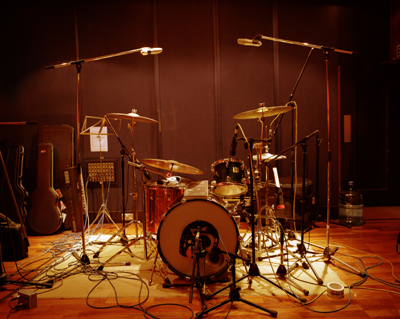 |
Microphone placement on a kick drum will change based on whether or not you're
in a recording studio or in a live sound setting. If you're in a recording
studio it's highly recommended to take off the drum head on the resonant side
of the drum. If it's a live sound environment you'll probably only get a hole
cut in the front of the drum and sometimes maybe you won't even have that.
If the head is off or if you have a hole in the front head make sure that the
front of the microphone is pointing directly at the center of the batter head
where the kick drum pedal impacts the head itself. This way the microphone
will have a better chance of picking up the attack of the drum.
In the same way when you begin setting up the mics on the other drums on the
kit, start with pointing the mics at the center of the drum. This is a great
place to start as it's probably where the stick is going to impact the drum
most frequently. It's important to remember that the microphone is going to
change how the drum sounds based on the placement of the mic. Do not start
eq'ing the drum before you consider changing the placement of the mic. As you
change the mic placement you will change the eq of the drum as the microphone
is in a way, an eq.
Another very important principle to remember is that with microphone placement
a small move with a microphone means moving the mic an inch, not inches. This
is also important to remember when considering trying to reject unwanted noise
from other drums on the kit.
Bleed through is when a microphone picks up unwanted noise from surrounding
instruments. Understanding the principles of microphone polar patterns is critical
when considering mic placement on any instrument, especially on a drum kit.
Dynamic microphones are typically used in the close proximity placement of
the mics on the drums themselves and condenser microphones are used when placing
overhead microphones. The dynamic mics should have at least a cardiod pattern
but a hyper cardiod pattern could be better rejecting unwanted noise. Microphones
with a cardiod polar pattern reject unwanted noise best from the rear. So if
you are mic'ing the snare drum it's important to put the rear of the mic pointing
towards the hihat. That way the microphone will reject the sound of the hihat
more effectively.
In the same way you put the snare mic in a place that will allow rejecting
the hihat from the head of the snare mic, it's important to do the same type
of placement with the rack tom and floor tom microphones. Placing the microphone
at the top of the drum will allow you to focus the head of the mic at the center
of the drum as well as have the rear of the mic facing the other cymbals set
up around the drum kit.
Close mic placement on drums can sometimes be frustrating depending on how
the drummer sets up the kit. Many drummers will place the surrounding cymbals
so close the to the drums it's almost impossible to get a microphone on the
drum. There are several different microphones made for these types of scenarios
and the mics are small and easy to clip onto the shell of the drum without
having to use a microphone stand.
One of my personal favorites is the Sennheiser E604. This is a great sounding
microphone for just about any percussion application and great at getting into
tight spaces. Another one is the Shure Beta 98. Either way you go you're still
trying to achieve as much isolation on the drum as possible without the use
of auxiliary dynamic processors such as gates, eq's, and compressors. |