This
month is the first of several articles discussing the electronics
inside a guitar. I have written a number of articles explaining
the circuitry of the guitar amp but equally important in
getting a desired sound is the signal coming from the guitar.This
month we will look at pickups. In the following months
the volume and tone controls, switches, jacks and finally
different ways of combining pickups to achieve a desired
sound.
PICKUPS
Obviously without a pickup to convert the vibration of
the strings to an electrical signal, there could not be
an electric guitar. Let's explore first how a passive (no
battery needed) magnetic pickup works, since this is what
is used the majority of the time.There are also two types
of magnetic pickups, the single coil pickup and the humbucking
pickup. Let's look first at the single coil.
SINGLE COIL PICKUP
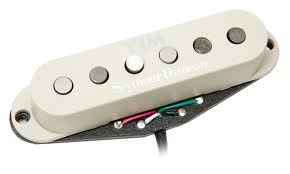
| This pickup is constructed using a magnet,
pole pieces and very thin wire. The basic principle
of how this pickup works is as follows: A coil of extremely
thin wire is wound around a plastic coil former and
placed directly over a magnet. Metal polepieces are
positioned inside the coil under each string. The polepieces
help focus magnetism directly to each string. As you
probably remember from high school science, a magnet
radiates an invisible field around itself called flux.
If you place the coil and the metal guitar strings
within the magnetic flux, the metal strings become
magnetized by their close proximity to the magnet and
pole pieces and the flux of the magnet is varied by
the movement of the vibrating magnetized guitar string.
Whenever a coil of wire sits in a magnetic field and
the flux varies a voltage is created (induced) within
the coil.The voltage created is analogous to the frequency
and dynamics of the note being played and can then
be output to an amplifier. Of course the amount of
windings, gauge of wire, magnet type and strength all
have a tremendous effect on the tone and signal level
coming out of the pickup. |
 |
Perhaps the biggest drawback of the single
coil pickup is its ability to output stray noise along
with the guitar signal. As we said above a variation in
a flux field that a coil of wire sits in will induce a
voltage in it. In our everyday environment there are plenty
of magnetic fields that exist in the air around us. These
come from power lines, air conditioners, lighting etc.
The power we use every day is an alternating voltage that
switches sixty times a second. This is similar in frequency
to a Bb on the E string of a bass guitar. If a guitar pickup
coil sits in a field of this sort, the coil will pick it
up and produce a noise signal at the pickup output. This
is the same principle that the antenna on a radio is used
for. It picks up magnetic waves generated by the radio
station's transmitter, although the radio waves are at
a much higher frequency than the noise we are talking about
here. It should be noted that when a pickup outputs stray
noise the pickup's magnet has nothing to do with it. It
is the coil alone acting as an antenna and producing the
noise. You could remove the magnet and it would make no
difference at all in the pickup's noise output.
One trick you can utilize to reduce noise in the pickup
is to vary the location of the pickup in relation to the
noise field. For example, If you hold the guitar with it's
volume up and spin in a circle as you listen to the noise
you will see that every ninety degrees of rotation will
either cancel or reinforce the noise.This is because the
pickup's physical orientation to the noise in the air determines
how much it will pick up, same as moving a radio antenna
around until you get the strongest reception. If the situation
allows, as in sitting down while recording, you can orient
yourself in the optimum position for minimum noise.
HUMBUCKING PICKUP
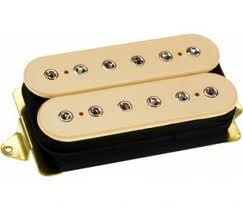
| Building on our explanation of how a
single coil pickup works, let's see how a humbucker
operates. The humbucking pickup is actually two single
coil pickups working together.What makes this different
than any other two single pickups used together? The
humbucker has two main differences. First the two coils
of wire are placed right next to each other and the
coil wires are wound physically in opposite directions
to each other as in one is wound clockwise and one
is wound counterclockwise. The second difference is
that each coil sits in an opposite polarity magnetic
flux in relation to the other coil as in one coil sees
the magnet's north pole and the other sees its south
pole. The important concept to understand is the difference
between how the humbucker reacts to stray noise and
how it reacts to the guitar signal. Let's take noise
first. As we said above a pickup can act as an antenna
to pick up any stray magnetic noise in it's vicinity.
In a humbucker it's two coils of wire are wound in
opposing physical directions resulting in a noise voltage
in one coil that is opposite in polarity to the noise
voltage in the other coil. |
 |
This
means that when the noise voltages of each coil get combined
together at the pickup's output they cancel each other
which is the same thing as when you add an equal positive
and negative number(+5 and -5 = 0). But something different
happens with your guitar signal. As the guitar string vibrates
in the flux of the magnet a signal voltage is induced in
each coil. Since the coils are out of phase (polarity)
with each other the first assumption would be that the
guitar signal in the two coils would cancel each other
just as the noise signal does. But remember we said before
the magnet has no influence on the pickup of noise but
does provide the magnetism to create the guitar signal.
And remember also that each humbucker coil is sitting in
the flux of an opposite magnetic polarity. The direction
of the flow of current in any coil is dependent on the
polarity of the magnet it is near. Therefore each coil
is being induced with an opposite flow of current. But
since the coils are also wound opposite each other (out
of phase) the current flow is flipped in the coils in relation
too each other and now adds instead of cancels. So the
end result is stray noise is significantly reduced due
to the out of phase coils and the guitar signal is boosted
because the two out of phase coils are brought back in
phase by the opposite polarity magnets. Therefore in comparison
to the single coil pickup the humbucker can actually reduce
stray noise and at the same time boost the guitar signal
above what noise is left.
ACTIVE PICKUPS
Even though a humbucker does a great job at reducing stray
noise it doesn't get rid of it completely. Unless the two
coils are wound to exactly the same resistance and winding
geometry some noise will get through. Additionally the
higher inductance of the two coils in series filter out
a lot of the high frequencies.Coil inductance acts as a
low pass filter, so the more inductance there is the less
highs you get. We also have a problem with the passive
pickup where there is a region on the guitar's volume control's
rotation where as you dial the volume control back from
10 you hear stray noise from the air increase until about
five where it starts to disappear. I am going to explain
this in detail next month when I explain the volume pot
but suffice it to say right now this is an impedance mismatch.
An alternative solution to address these problems is to
use an active pickup. This pickup is actually a passive
pickup with weaker magnets and much less coil windings.
In a passive pickup we use strong magnets and big windings
to create a large enough signal level but we also have
all the attendant problems mentioned above, An active pickup
has weaker magnets and fewer windings giving it less susceptibility
to noise pickup and lower inductance in regards to losing
high end. This creates a pickup with a flat frequency response
and less stray noise. The problem here is its output signal
is weak. This is where the active part comes into play.
Pickup brands such as EMG include an onboard preamp built
inside the body of the pickup. This is what the battery
needed for the pickup is powering. This preamp takes the
weaker signal of this type of a pickup and boosts it to
a higher level compatible with the output level of a passive
pickup. One other advantage of the active pickup is the
the output of it's onboard preamp is at a much lower impedance
than a passive pickup.This allows the use of lower value
pots on the guitar typically 25k as opposed to the 250k-500k
used with a passive pickup. This helps reduce noise mentioned
above created when the volume control is dialed back from
ten as there is much smaller impedance mismatch. The lower
impedance of the pickup also means that the cable quality
and length used to connect the guitar to the amp has less
ability to suck high end from the signal because at lower
impedances the cable capacitance per foot ( which is what
bleeds off the highs) has less influence on interacting
with a guitar signal than it does with a higher impedance
passive pickup.
There are several things some players consider
drawbacks to using active pickups. First, the necessity
of a battery becomes a problem when the battery becomes
weak. The pickup doesn't stop working abruptly, but it
starts to sound really bad. If this happens while performing
in the middle of a set, first of all it may take some time
before you even realize it is the weak battery that is
causing poor sound and then you can't just stop and change
it during a set.
Secondly, if the sound in your head is one that needs to
be created by the sonic signature of the unique combination
of magnet type,magnet strength and specific coil winding
of a passive pickup, then a flatter response active pickup
will not get you there.
Thirdly, some active pickups have way more output than
a passive pickup. To a player who is not aware of this
he may run into the following problem: I have seen people
think they have a problem with their amp because they can't
get a clean sound even with the amp turned way down. What
is actually happening is the the higher output active pickup
is overloading the input circuitry of the amp causing it
to distort. Since the amp's gain and volume controls are
further down the line after the input circuitry there is
no way to adjust out this distortion on the amp itself
ACOUSTIC GUITAR PICKUPS
We use a different type of pickup for acoustic
guitars. Yes you can add a magnetic pickup in the sound
hole of an acoustic guitar. You may remember the Epiphone
J-160 acoustic that John Lennon played with the volume
and tone controls located right on the front of the guitar.
Although any magnetic pickup is slightly microphonic, and
there is also some amount of wood resonance that is reflected
back into vibrating the strings, an acoustic guitar with
a magnetic pickup has a mostly electric sound.
| The modern acoustic guitar
pickup system is made from a material called a piezo
crystal. This material has a unique property that when
pressure or vibration is applied to it a voltage will
appear across it varying in volume and frequency relative
to the vibration imposed on it. If you use piezo crystals
to construct a pickup that sits underneath the guitar's
bridge saddle it will be vibrated both by the strings
and the resonance and decay envelope of the guitars
wood. This creates an output signal very similar to
what the acoustic guitar projects into the air to our
ears. You get a signal that very much sounds acoustic
and can be put into an amplification system.One other
benefit of the piezo is that in can be installed in
a nylon string guitar as steel strings are not needed
to make the pickup work as with a magnetic pickup |
 |
Of course there is a drawback to the piezo
pickup. Its impedance is very high compared to magnetic
pickups or line level signals. Therefore if you plug a
piezo directly into a guitar amp or mixer whose input impedances
will typically run between 600- 1 million ohms you will
have an impedance mismatch causing the piezo pickup to
lose volume and bass. Remember that any input impedance
needs to be ten times greater than the source impedance
feeding it. So we are left with three ways to fix this.
Raise the receiving devices input impedance up to around
5 megs which is impractical for the average person, use
an amp already designed for a piezo (many acoustic amps
have a higher input impedance for just this reason) or
lower the impedance of the piezo pickup before it gets
to the amplifier input. The latter is what is commonly
done. The piezo pickup's output is run into a circuit called
a buffer. The buffer presents a very high input impedance
to the piezo so none of its sound is lost. The buffer output
is at a very low impedance perfect for driving any common
guitar amp or mixing board. This is the main function of
the battery powered preamp installed on the side of most
acoustic guitars sold today although manufacturers like
to add volume EQ and tuning functions to the preamp to
increase the guitars functionality and sales appeal.
In summary above
are the most common types of guitar pickups
There are quite a few brands of pickups all competing for
your dollar and all have different qualities. It is hard
to verbalize differences in sound so the best way of testing
tone is by trial and error comparisons. Unfortunately this
is a hard route, because you must test pickups in the specific
guitar and pickup position you desire. To make a comparison
after listening to a pickup you must uninstall the pickup
and then install the second pickup to be auditioned. Our
brain can not actually remember subtleties of tone for
this long making the comparison results highly subjective.
I have been involved with A/B testing of electronics where
instantaneous switching between devices is possible. All
the subtle differences can jump right out at you as you
instantly switch between the two devices being compared.You
learn very quickly that non instantaneous testing as in
testing pickups leaves a wide margin of imagination. But
this is usually all we have with pickup testing so it is
what it is. Next month we move on to how the pickups are
wired in the guitar.
|