|

By
Chuck Kirkpatrick
how many countless hours
have been spent discussing this topic?
It was one evening sometime around 1979 at Quadradial
Studios in North Miami where I heard a compact disc for the first
time in my life....and it was like having knives and forks blasted
into my eardrums. If ever the word "brittle" could
apply, this would have been the occasion.
Digital audio and the compact disc have certainly
come a long way. I cannot elaborate on nor will I attempt explain
the technical side for lack of education, but the truth about
digital audio is, is that it is very simply, the truth. Save
for the almost imperceptible effects of sampling (some will beg
to differ) and the quality of the A/D - D/A converters employed, "digital" neither
adds nor takes away anything from the original audio signal
Looking back
at the recording process 30 or more years ago, we begin
with the microphone where the energy conversion from mechanical
to electrical first begins. And from there to the final
destination - the loudspeaker (where the electrical energy
goes back to mechanical) - that electrical signal makes
it's journey through a maze of iron (transformers), air
(capacitors), carbon and metal (resistors), then through
vacuum tubes, more resistors, capacitors, transformers,
and wire. For storage purposes, yet another conversion
of electrical energy to magnetic energy takes place via
a small coil (the record head of the tape machine) to rearrange
random molecules on a strip of thin plastic tape coated
with iron oxide into an organized linear array. Scraping
past the record and play heads of the tape machine at over
a foot per second, this magnetic array is once again converted
back to electrical energy and continues yet another journey
through much the same as above. When you listen to those
old recordings now, it's astonishing how good most of them
sound ...perhaps too good?
All similarities end at the A/D ("analog-to-digital")
converter where the analog audio signal is sliced up
much like a hard-boiled egg, and each slice is a measurement
of the audio signal at a particular point in time, represented
by a binary number. From here on throughout the chain of
equipment, this number remains unaffected, and as long
as it is properly "clocked" in sequence with
measurements before and after it, the audio signal these
numbers represent remains unaltered. |
|
Noted engineer/producer Don Gehman once
made a great analogy... "analog
is like film and digital is like video. I prefer to work in film." There
is that certain "warmth" in analog, much like the
gorgeous color saturation associated with good film that, until
a few years ago, was lacking in pure analog video recordings.
However, we have seen huge advancements in digital video quality
as well as digital audio that bring a new treat to the listener/viewer
. I was amazed to learn that "The Shield" Fox cable
series was shot all in pure video but made to look like film
via digital technology.
 |
I'm
always amazed at the "fatness" of
the kick and snare on some of my old Game recordings from
Criteria, all done to analog multi-track tape. I understand
why so many producers still track to analog tape, then
transfer to digital for ease of editing and tape preservation.
And look at all the plug ins available for digital workstations,
all designed to emulate good old analog equipment by
degradation of the audio signal! And it is that actual
degradation (I hate using that word in this context) that
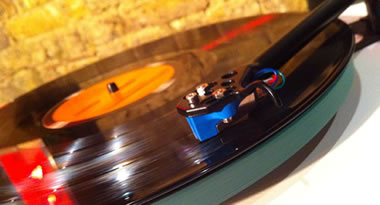
we have come to love in our old vinyl and tape. The top-end
harshness is smoothed, the bottom-end is fattened, and
rich pleasing harmonics are generated...all this stuff
that was never there to begin with!! And here we are now
in an era where a laptop computer is capable of doing what
once took half a million dollars' worth (and 3 tons) of
equipment to do, and does it more accurately. Our track
limit in the old days was 24 - unless you synced up more
tape machines (and you old-timers know what what a nightmare
that was). Today, there is virtually no limit to the number
of tracks available if your processor and RAM are adequate. |
Imagine for a moment if you will, where the music biz - and
music itself - would be without digital audio today. No downloading,
no I--Tunes, no I-Pod, and still having to depend on FEDEX to
deliver rough mixes for approval on DAT (remember that format?)
reel-to-reel, or cassette. Every cassette tape you ever bought
was a third or more generation copy, complete with all the hiss
and signal degradation and even further twisted by 6 different
flavors of noise reduction. Every commercially released vinyl
record was mastered from 2nd generation safety tape copies.
Digital is here to stay...and I am glad.
I wouldn't have a job otherwise. The real beauty is, it's nothing
but a bunch of "ones" and "zeros" -
little switches that are either "on" or "off".
Digital copies can go dozens of generations with absolutely no
signal degradation, just so long as those "ones" and "zeroes" remain
as they are supposed to.
I just finished an album, most of which
was done in a 10 X 11 bedroom and on equipment that I could
fit in the back seat of my car. Sure....I would have loved
to have done it on 2" 24
analog through a Neve console. But in the end, it's the expression
on the canvas that matters, not the paints, brushes or easel.
Chuck Kirkpatrick
has worked on numerous million selling and legendary
recordings. While working as a house engineer at the
now legendary Criteria Studios in Florida Chuck's
impressive ‘60s and early ‘70s, historic engineering
feats included a number of well-known
rock artists. Chuck
currently performs with the group "Rock
And Roll Circus" and can be reached at ckirkp1021@aol.com.
|
|