|
This month is the fourth article in a series
about speakers. We will look specifically
at the development of bass guitar speaker systems from
the fifties to the eighties. Outside of the obvious difference
that bass guitar speakers need to reproduce lower frequencies
than guitar speakers, there are a few other differences.
The way a guitar speaker may distort when over driven is
one. Also, the fact that some guitar speakers are less
efficient in regards to how much volume they produce with
a specific input power, as opposed to another model speaker,
may be a factor in letting you drive a tube amp's output
stage harder for more distortion at a lower volume. We
look for the opposite things with bass speakers. Hi-fi
reproduction, high efficiency and larger speakers (15" and
18"). Bass speakers include larger magnets and voice
coils and are mounted in cabinets that boost the efficiency
of the speaker in the low frequencies. What I will touch
on here are what I see as the main icons in the development
of bass guitar systems. There were many others from different
manufacturers with some interesting variations, but I see
these icons as milestones in the development of bass amplification.
FIFTIES TO EARLY SIXTIES
In the fifties and early sixties bass amps
were little different from
guitar amps. The early Fender Bassman amps show us this
as they have
become some of the most coveted vintage guitar amps. Those
amps had open back
cabinets trashing the lowest octave of the bass due to
phase cancellation
and forty watt max tube power which did not produce much
volume. Of course in
those days people were not playing at extremely loud volumes.
It is also
interesting how your brain kind of fills in the missing
low octave information
missing from the output of those amps.
As time went on and rock music developed
further in the mid-sixties, there was a need for louder
reproduction of the bass guitar. This was a tough road
at first because as opposed to the guitar it takes a lot
more amplifier wattage to make the bass frequencies louder.
Since the amps
at the time were basically limited to 100 watts maximum,
be they tube or solid state, this was pretty much the same
wattage the guitarists were using. The first improvements
we saw to
bass guitar systems was to mount the speakers into closed
back cabinets. This
eliminated the problem of the speakers rear wave canceling
the front wave and
brought up the volume of the lower frequencies. Manufacturers
started using
fifteen inch speakers rather than twelve's, so by using
a dual fifteen inch closed back
cabinet the bass player finally had something to project
a fairly full sounding bass guitar
at a reasonable volume, at least for the times. And of
course adding several cabs and amps
together for larger stages became the norm.The most notable
amps from this era were of course the sixties Fender Bassman
and Dual showman series, But Ampeg also was a strong force
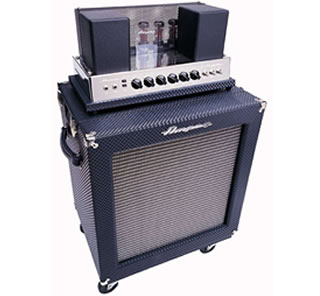
during this period. The Ampeg B-15, although not more than
40 watts with a single fifteen inch speaker, became an
extremely popular amp especially for recording. Countless
rock and soul hits were recorded on this amp as it was
usually the house amp in many recording studios. The B-15
amp had a unique design in that the amplifier chassis that
sat on the top of the speaker cabinet was able to be flipped
upside down and stored inside its speaker cabinet for easier
transport. But without a doubt this amp had a sought after
tone for bass guitar. During this period, aside from their
open back guitar amps (Gemini,Reverbrocket etc), Ampeg
had other larger amps in their Fliptop series but for whatever
reason, probably their size and weight, never really caught
on.
MID SIXTIES
By the mid to late
sixties rock music was getting louder and the venues
larger. The amps of the early sixties were not cutting
it anymore and manufacturers strove to bring new
and more efficient (louder) designs to the marketplace.
At this time transistor development had reached the
point where amplifiers in excess of 100 watts were
available (or at least until they blew up!). Standel,
a manufacturer of amps that began building amps in
1953, brought out the Super Imperial amp. It had
a solid state amp section and a cabinet with two
fifteen inch Altec-Lansing speakers.
The cabinet was
ported and as we discussed in an earlier article
in this speaker series porting the cabinet can increase
the bass response of the cabinet as compared to a
similar sealed cabinet. The amp was a leap forward
in volume and players using a pair of them was seen
on many stages at the time. Another company with
a similar approach was Kustom. They produced ported
two fifteen inch speaker cabinets containing good
speakers as in JBL's or Altec -Lansings to be used
with their solid state amplifier heads. While Standel
and Kustom were two leaders in manufacturing of bass
systems they were different in several ways. The
Standel amp was an integrated amp and speaker combination.
Kustom had separate cabinets and heads allowing the
use of multiple speaker cabinets.
|
|
Kustom went so far as to create ported
cabinets containing three fifteen inch speakers to be used
with their 250 watt head and also sold a matching cabinet
with an onboard 250 watt amp. You could combine as may
of these powered cabinets as you liked with the head to
scale the system as large as needed. Another difference
between the companies was that Standel would pot their
circuit boards in epoxy both to protect their circuit design
from copying and allegedly to make it more reliable.At
one point, a bad batch of these modules was produced and
since they were unrepairable, it led to Standel's demise.
On the other hand, Kustom produced solid, repairable amps
with high quality components and packaged it in their now
iconic Tuck and Roll padded coverings available in many
colors. The port tubes were chromed and set right in the
front black grill. The amps were eye catching to say the
least. One other unadvertised benefit of Kustom was if
the whole band used Kustom amps at the end of the gig you
could load them in the equipment truck and create a giant
bed. "Load the truck flat" was probably an expression
heard at the end of many gigs in the sixties and I'm sure
you know why.
The next amp to appear on the scene in
the late sixties was the Acoustic 360. Here we have
a head that is only a preamp. The speaker cabinet contained
a solid state amp in its bottom. The preamp had the ability
to drive up to four powered cabinets. The important thing
about the Acoustic 360 is the speaker cabinet design. The
design is called a W folded horn. It contained an 18" Cerwin
Vega speaker firing backwards into a wooden folded horn
design (I explained this in an earlier article) that routes
the sound out the front of the cabinet. This is a tremendous
efficiency increase over any other bass system of the time
and allowed the two hundred watt power amp to achieve very
high sound pressure levels. In the late sixties players
using a pair of these were seen on many a concert stage.
A drawback of the 360, besides amplifier failure (solid
state amps were still pretty unstable in those days), was
that although they were efficient and loud the actual volume
of the amp's lowest frequencies developed further away
(almost twenty feet) from the amp due to the long wavelength
of the bass notes. A player standing in front of the amp
on stage wasn't hearing the same sound as someone twenty
feet in front of the amp. This is due to the fact that
the W horn actually reproduced those low frequencies. Also,
the 18" speaker due to the mass of the cone did not
have the most defined sound as its response time to the
higher frequencies is limited by the mass of the cone imparting
momentum and making it harder for the cone to easily move
back and forth. Acoustic addressed this problem by including
an external speaker jack with the lower frequencies removed
so a smaller extension cabinet could be added to reproduce
the mids and highs. Unfortunately I don't think many players
were aware of this.
SEVENTIES
|
Moving on to the
early seventies brings the next major development
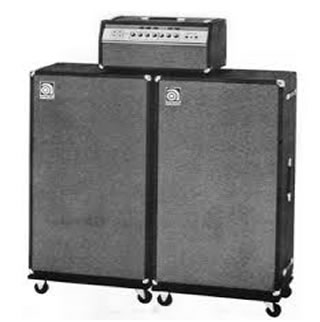
in bass guitar systems, the Ampeg SVT. In this system
Ampeg created a three hundred watt tube head. This
head was massive in weight but also in tone. It could
outdo many of the solid state designs of the time
as although it was three hundred watts driving it
into distortion gave you more volume. A tube amp
distorts more warmly than a solid state amp which
is not musical when it distorts so the SVT had an
edge in this respect. But the main thing we are discussing
here is speaker cabinets and this is the major point
of the SVT. Ampeg loaded the cabinet with eight ten
inch speakers. They used eight 32 ohm speakers in
parallel creating a net impedance of four ohms.
The
eight ten inch speakers had several distinct advantages
over the single 18" Acoustic 360. First of all
the speakers were configured in what is called a
line array so the surface area of the individual
speakers combined together into a single wave front
acting as a much larger speaker capable of producing
a big low end. Wiring the speakers in parallel also
lowered the branch inductance of the cabinet allowing
the amplifier to control the low end better than
cabinets with series-parallel connected speakers
.The cabinets were sealed and not ported and along
with the fact that the ten inch cones havie much
less mass than an 18" or 15" cone were
capable of a snappier high end. The SVT replaced
the Acoustic 360 as the choice for touring concert
bands and is still manufactured today. |
EIGHTIES
In the eighties two developments
occurred. First, transistor development had improved
immensely and there were now high wattage power amps
that were fairly reliable at a reasonable cost. The Peavey
CS-800 is a great example of this. Secondly the trend
in guitar amplification by the mid eighties was rack
systems. Many guitar players, instead of plugging into
a dedicated combo or stack guitar amp, would assemble
a guitar preamp, several effect multiprocessors and a tube
or solid state rack mount power amp and plug the output
into a speaker cab. Bass players followed this idea and
assembled a bass guitar rack preamp with a solid state
power amp. This setup could feed the cabinet system of
their choice. During this period there was a plethora of
PA speaker cabinets available in many styles and it became
popular to assemble a stage bass guitar system that resembled
a mini PA system. If an electronic crossover was added
into the players rack equipment the bass sound could be
split into multiple frequency bands (low/hi or low/mid
hi) each feeding its own power amplifier plugged into a
speaker cabinet optimized for the particular frequency
band. I played in one band where the bass player used a
biamp setup to drive a 2-18" scoop cabinet. A scoop
cabinet is a variation on the folded horn cabinet. The
speakers face forward at the top of the cabinet and the
speakers rear wave is merged in phase with the front wave
down a curved piece of wood (the scoop). For the high frequencies
of the bass an Ampeg SVT cabinet was placed on top of the
scoop. This was a pretty loud and intimidating looking
system. Another guy I played with used a triamp system
consisting of two double 15" Thiele (ported) cabinets
with two more single twelve inch Thiele cabinets. On top
of this was placed two radial PA horns. This was a loud
powerful system that broke down into smaller, easier to
move elements,
Next month we will move on and discuss
the bass systems from the nineties through today.
Many of the vintage amps are still being used, but we will
see that advances in technology and newer styles of music
have brought some modern designs to the market.
Steve
Weiss is the owner and main technician of Steve Weiss
Electronics Inc. He is experienced in the repair
of analog and digital musical equipment. This includes
everything from Vintage Tube Amps and Pro Audio equipment
to Digital Keyboards There is also a guitar repair
shop staffed by some of the areas top guitar repair
techs. He is authorized for warranty work on most
major brands. Steve Weiss Electronics is located
inside of Sam Ash Music at 5460 West Sample Road
Margate, FL 33073 954-975-3390 Ext 272. Steve has
also spent 25 years on the road as a performing guitarist
and is the designer of Primal Guitar amps that can
be seen at Primal
Audio.com Steve can also be reached at stevew@metromusicmayhem.com |
|
|