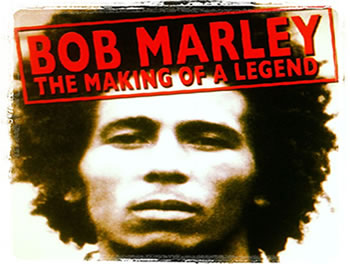
|
Invited to more than 30 film festivals
worldwide, starting with the European Premiere at the EDINBURGH INTERNATIONAL
FILM FESTIVAL and North American Premiere at the RHODE ISLAND INTERNATIONAL
FILM FESTIVAL, winning four international awards, including the UNESCO HONOR
AWARD at the JAMAICA REGGAE FILM FESTIVAL.
Based on footage shot in the early seventies and lost for more
than thirty years, NAACP IMAGE AWARD winner Esther Anderson takes us on a journey
to Jamaica and into 56 HOPE ROAD, Kingston, to see and hear the young BOB MARLEY
before he was famous. The film shows us the WAILERS' first rehearsal, when
the idea of a Jamaican supergroup like the BEATLES or the STONES was still
just a dream. We sit in on the launch of their international career with "GET
UP STAND UP", "I SHOT THE SHERIFF", and the "BURNIN'" and "CATCH
A FIRE" albums that brought to the world REGGAE music and RASTA consciousness
together as one, starting a revolution that would change rock music and contemporary
culture.
After 30-some-odd years, and even after his death,
there might still be a side to reggae legend Bob Marley very few have
seen. Esther Anderson, a close friend of Marley from as early as the
1970s, when the reggae icon was still relatively unknown outside Jamaica,
will release a documentary on the legend. Titled Bob Marley - The Making
of a Legend, the feature will have footage previously thought to have
been lost. According to a story on bbc.com, released days ago, Anderson
had left her career as an actress to try to help promote Marley whose
first album was not doing well.
Catch A Fire caught fire before Anderson
released the footage, which she had thought was lost at Island Records
on Old Hope Road (today it is The Bob Marley Museum). The BBC report
says the film charts the rise of Bob Marley and The Wailers. The report
also indicates many other elements of Marley's life that are well known.
Anderson is quoted for instance, as saying, she thinks if Marley were
alive today, he would still be breaking hearts. More to the point, however,
the article points out that, even at that stage, (according to Anderson)
Marley had the very recognisable makings of a star - though he never
knew it. |
|
Thus, the idea of filming intimate moments that would
bring that star power into focus was the point of making the film. The article
also points out that Anderson, who had just done a film with Sydney Poitier,
had to use her own money to make the film because the project was not backed
financially by Chris Blackwell's Island Records. "I had no budget. Chris said go ahead
but I had to do it on my own. So I gathered a crew and equipment and I started
to film," the article quotes Anderson as saying. Anderson also speaks
intimately about what life was like with The Wailers during the time she made
the tapes. According to her, the original Wailers spent much of their time
at Island Records discussing "philosophy, the sufferings of the people." Her
memory of things of that nature is captured on the film and with photographs.
The article claims that Anderson played an integral role in leading Marley
to Rastafarianism. That marriage came through a meeting with Ras Daniel Hartman,
who she is said to have introduced to Marley. That meeting also showed, according
to the article, the potential of strengthening the link between Rasta and reggae,
a link that today seems inextricable. "The red, green and gold and all
of that were my ideas," Anderson is quoted as saying in the article. "I
shot the thing and put it together and sent it over [to London]." The
images, as have become popular knowledge, were used to sell Marley's image
- the most memorable, of course, being the picture of Marley smoking a spliff.
|
The recordings haven't just been found though, as
it was approximately 11 years ago that Jeremy Marre, a British documentary
maker, had a meeting with Anderson. From that meeting, stemmed a relationship
that would lead her to the tapes. Marre had actually gathered the tapes
among archive material he had intended to use. The film, called Bob Marley
- The Making of a Legend, is made with Gian Godoy and will be presented,
though not in finished form yet, at the British Film Institute in London
as part of the African Odysseys programme.
The programme, which seeks
to reveal little-known facts about black history will also feature 'I
Heard It Through the Grapevine'. That film, produced by Dick Fontaine
and Pat Hartley, is a film essay, written by James Baldwin. The film
seeks to speak about the civil rights movement, what works and what didn't.
It features Baldwin, his brother David, Chinua Achebe, Fanni Lou Hamer,
Amiri Baraka, and other friends Baldwin made during the '60s. Baldwin
takes a critical look at the strategies and tactics used by the black
community in the '60s during the civil rights movement.
“To tell you the truth, baby, belief kill and belief
cure. … Everything is political if you think of it as political.
I’ll never be a politician or think political. I just deal with
life and nature. That’s the greatest thing to me. Life.” True
fans of the late, great Bob Marley won’t want to miss “Bob
Marley: The Making of a Legend” when it makes its Hawaii premiere
at this year’s Hawaii International Film Festival — if for
no other reason than to see some amazing archival footage captured by
Marley’s former girlfriend and collaborator, Esther Anderson. |
There isn’t much
of a message, or even a storyline to the 90-minute documentary, which blends
clips from 1973 with updated scenes and interviews from many of the same locations
filmed in 2000. Anderson could have just as easily called this movie “The
Smoking Sessions” or “The Herb Chronicles,” as much of the
Marley footage captures him in chill mode, smoking spliffs and waxing poetic
about politics and religion. But even with the slight lack of focus, it’s
easy to get caught up in the historical and cultural significance of what Anderson
has chosen to share in this film. (Especially entertaining is a clip of Marley
sparking one up with Peter Tosh, then getting into a back-and-forth about why
his Jeep’s engine won’t start — who knew Peter wasn’t
just a musician back then, but a budding mechanic, too?) Keep in mind that
when all this was filmed, Marley had yet to realize the global superstardom
that would eventually come his way. In scene after scene, he stands shirtless
with nappy dreads that are just starting to grow, gazing into the camera with
what seems like a mixture of amazement and annoyance.
In one clip, Marley shows
off his own “special effects,” while another captures a look that
makes you wonder if he’s about to knock the camera out of Anderson’s
hands. Despite the poor video quality, there’s no mistaking the value
of the footage and Anderson’s insight into Marley’s travels during
the early ’70s. Viewers learn, for example, that “Get Up Stand
Up” was based upon Marley’s experiences during a trip to Haiti,
and that “I Shot the Sheriff” was actually inspired by Anderson’s
quest to acquire birth control pills while in England with Marley in 1973.
But the most amazing scene, by far, is the Wailers’ very first rehearsal
together. We see Marley, Tosh and Bunny Livingston show up at Hope Road in
Kingston, followed by clips of Marley working out his vocals while strumming
a guitar. Those shots and footage of Marley actually sitting down to write
some of his future hits is simply mind-boggling to dedicated fans of the legendary
reggae artist. HIFF has just one screening of “Bob Marley: The Making
of a Legend” planned. I hope it takes place in one of the bigger theaters
at Dole Cannery, so as many of his Hawaii fans as possible have the chance
to watch this film.
|