Each
month we will be checkin what we feel is an album that definitky
may be worth revisiting. Sometimes it is easy to forget how
great some of these releases were. Many of them went on to
have signifigant influence on the music of today. When going
back and checking them out again you will often find forgotten
brilliance and just maybe it will give you a new spark of inspiration
for creating something awesome on your own. (-: Thanks to Wikapedia
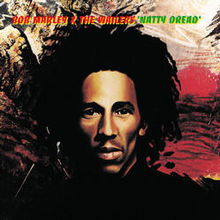
Natty Dread is a 1974 reggae album by Bob Marley & The
Wailers. An important transition in Marley's discography, Natty Dread
was the first album released as Bob Marley & the Wailers (as opposed
to The Wailers) and the first recorded without former bandmates Peter
Tosh and Bunny Wailer. It is also the first album recorded with the I-Threes,
a female vocal trio that included Bob's wife, Rita Marley, along with
Marcia Griffiths and Judy Mowatt.
Natty Dread peaked at No. 44 on Billboard's (North America)
Black Albums chart, and at No. 92 on the Pop Albums chart. Natty Dread is a spiritually charged political and
social statement. It opens with a blues-influenced positive celebration
of skanking, reggae and sex, "Lively Up Yourself", which Marley
used to open many of his concerts, in order to get the audience worked
up; American R&B star Prince used it for the same purpose. The original
and still unreleased demo of the Island version of "Lively up Yourself" was
recorded in 1973. This was the last time all three original Wailers (Bob
Marley, Peter Tosh and Neville "Bunny" Livingston) recorded
together in a studio. This version featured each Wailer singing a verse
each. |
|
"No Woman, No Cry", the second track, is probably the best known
recording on the album. It is a nostalgic remembrance of growing up in the
impoverished streets of Trenchtown, the ghetto of Kingston, Jamaica, and the
happiness brought by the company of friends. The song has been performed by
artists as diverse as Boney M. (sung by Liz Mitchell), The Fugees, Pearl Jam,
Jimmy Buffett, Rancid and Gilberto Gil. Songwriting credit for "No Woman,
No Cry" went to V. Ford. Ford, better known as Tartar to his friends and
neighbors, had been a kind friend of Marley as a child in Trenchtown. Marley
claimed he would have starved to death on several occasions as a child if not
for the aid of Tartar. The original version of the song was a gospel version
of the song featuring Peter Tosh and some unknown female backing vocals and
was cut for Island in 1973.
"Them Belly Full (But We Hungry)" is a warning against allowing
a nation's poor to go hungry, with the prophetic warning "a hungry mob
is an angry mob", while "Talkin' Blues" and "Revolution" go
deeper into controversial political commentary. "Rebel Music (3 O'Clock
Roadblock)" is a reflection on the potential impact of reggae music on
Jamaican society. The song was written after Marley had been stopped by a night-time
police carcheck. The influence of Marley's increasing devotion to Rastafari
can be heard in religious-themed songs like "So Jah S'eh", "Natty
Dread" and "Lively Up Yourself", while Marley's reputation as
a romantic is confirmed with smooth, seductive songs like "Bend Down Low".
The title track of the album takes its title from an idealised personification
of the Rastafari movement, Natty Dread.
Jazz guitarist Charlie Hunter covered the entire album
is his 1997 release of the same name. In 1975, this album was mentioned in
a few audio magazines as being ready to be released on Quadraphonic 8-track
tape. This never happened. However, the Quadraphonic mixes of "Lively Up Yourself" and "No
Woman No Cry" have been bootlegged from the master tapes and are available
on the internet. In 2001, a re-mastered edition of Natty Dread was released
by Universal Records containing a bonus track. In 2003, the album was ranked
number 182 on Rolling Stone magazine's list of the 500 greatest albums of all
time.
Although the album's liner notes list multiple
songwriters, including family friends and band members, all songs were written
by Marley. Marley was involved in a contractual dispute with his former publishing
company, Cayman music.
Vincent Ford, a childhood friend from Jamaica, was given
writing credit for "No
Woman, No Cry" on the 1974 album Natty Dread, as well as the songs "Crazy
Baldheads" (with Marley's wife Rita), "Positive Vibration" and "Roots
Rock Reggae" from the 1976 album Rastaman Vibration, along with "Inna
De Red" and "Jah Bless" with Marley's son, Stephen.
Marley had not wanted his new songs to be associated
with Cayman and it had been speculated, including in his obituary in The
Independent, that he had put them in the names of his close friends and family
members as a means of avoiding the contractual restrictions and as a way
to "provide lasting
help to family and close friends".
Marley's widow and his former manager Danny Sims sued to obtain royalty and
ownership rights to the songs, claiming that Marley had actually written the
songs but had assigned the credit to Ford to avoid meeting commitments made
in prior contracts. A 1987 court decision sided with the Marley estate, which
assumed full control of the songs.
|