Last month I explained how guitar pickups work. This month
we move on to the other components inside the guitar
that the pickups connect to. At first glance, the electronics
inside the guitar appear fairly simple and physically
they are, but in an electronic sense there is more than
meets the eye going on.
VOLUME POT
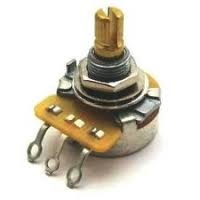
The volume pot (short for potentiometer)
enables us to control the volume of the guitar and
for an astute player it can be used to vary guitar
tone in relation to distortion. A volume pot is actually
a variable resistor. If you take one apart you will
find a circular trace of carbon printed on a non conductive
backing. Each end of the carbon trace is connected
to a terminal that a wire can be soldered too. A third
terminal, in between the other two, is connected to
a movable conductive wiper turned by the shaft connected
to the knob on the front of the guitar.
The wiper traverses
the carbon trace and according to where it is set
on the trace taps off the resistance of the trace
at that point. For instance, if we have a pot that
has a value of 10,000 ohms, if you measure between
the outside terminals on an ohmmeter you will read
10,000 ohms between the terminals. If you leave one
ohmmeter probe attached to one of the outside terminals
and place the other probe on the center terminal
you will see the resistance vary as you turn the
shaft which moves the wiper across the carbon resistor
trace. |
 |
According
to where the wiper is sitting at any given time the resistance
will vary between zero ohms (wiper positioned closest
to trace probe is on) and 10,000 ohms (wiper positioned
at terminal on other side). If you were to move the probe
between the two outside terminals at different positions
of the wiper you would note that as the resistance increases
between one outside terminal and the wiper terminal,
it is decreasing between the wiper terminal and the other
terminal. If you add the two values you get between the
two outside terminals and the wiper at any given point
it would total to 10,000 ohms. Therefore we see that
wherever the wiper is set we are dividing the resistance
proportionally. This is the standard way a volume pot
is connected to a pickup and is called a voltage divider.
The pickup output is connected to one of the end terminals
of the pot and the other pot end terminal is connected
to ground. The signal output is taken from the center
terminal. As we said above as the wiper traverses the
carbon trace the resistance varies.When the pot is on
full there is no resistance between the wiper and center
terminal and maximum signal flows to the output. When
the pot is turned to zero the wiper is hooked to ground
and no signal passes to the output. An additional benefit
of this is that the input to the amplifier is also held
at ground silencing the amplifier. If it didn't hold
the amp input at ground you would hear about the same
amount of noise you hear when the amp's volume control
is turned up and the other end of the cable is not plugged
into the guitar.
Another point about volume controls is that even when
they are on ten there is still a connection between the
pickup and ground through the resistance of the carbon
trace. This creates a load on the pickup lowering its output
and varying its tone because of impedance mismatching between
the pickup and pot. Obviously the higher the resistance
of the pot the less load is put on the pickup raising its
output and treble content. Why then it could be asked is
a higher value control not always used? Most people have
noticed that a single coil pickup is normally paired with
a 250K pot and a humbucker is paired with a 500K pot. Why
not use a 1 meg (million) pot for all pickups and have
the least load? As it turns out the way this is looked
at by pickup designers is that there should be a specific
load damping the pickup. This serves to smooth out its
response and generally the values stated above work well.
In the Nineties Gibson decided that the pickups they were
currently using sounded best with 375K controls. This is
something to watch out for if you have one of these guitars
and are upgrading to replacement humbuckers. Those pots
should be changed to 500k to prevent the guitar from sounding
dull.
It can also be said that the entire circuit from the pickup
to the volume/tone pots and including the front end circuitry
of the amp all work together as one circuit to create tone.
This is why the same pickups can sound radically different
when installed in different guitars or used with different
amps. Even different pots of the same value can sound different.
Since the carbon trace is printed on a non conductive wafer
which is held in place by the metal pot cover that is connected
to ground there is potential for the wafer to act like
a capacitor and pass highs to ground. Different composition
wafers can have different capacitances and also ESR (equivalent
series resistance) making two different pots in the same
circuit affect the tone of the guitar differently. It's
subtle but replacing the pickup on a guitar from a player
who really knows how his guitar sounds can be noticeable.
One other major difference between two pots of the same
value is their taper. Taper is the amount of change in
resistance per degree of pot shaft rotation. There are
two main types of taper linear and audio(log). Linear has
an equal amount of resistance change per degree of rotation.
Therefore if you set a 500K pot to 5 you will measure 250K
between either outside terminal and the center terminal.
Linear taper does not always work well in audio circuits
because the pot does very little until it is turned past
six or seven. This is because audio circuits (and the way
our hearing works) are logarithmic. The log pot lays out
the change in resistance per degree of rotation in a fashion
that helps the pot give usable control over the signal
level from a wider amount of the pot's rotation. Unfortunately
there is no standardized log pot taper. It can vary greatly.
This is why sometimes when you replace a log pot in your
guitar with another log pot the control range of volume
seems different. There is usually no way of knowing if
it will be different until you try it unless you can find
an exact replacement control for what was originally used.
Sometimes a manufacturer will label their pots with a code
informing us of the taper. You might see 100K 10A. This
means that when the 100K pot is set to 5 it has 10% of
the resistance (10K). If the pot said 20A it would be 20K
at half rotation. These codes I see often on the pots used
in amplifier circuits and unfortunately, I don't usually
see it on replacement pots from companies such as All-Parts.
One problem that comes up using standard passive high
impedance guitar pickups is that there often is a region
on the volume pot rotation where noise gets added to the
signal. This can start as soon as the pot is set below
full output usually occurring between nine and around six
.The noise starts to diminish as the pickup is dialed below
five. This of course is of great annoyance to anyone who
likes to vary their distortion tone using the guitars volume
control. The reason for this is an impedance mismatch is
created raising the impedance of the pickup system enabling
it to act as an antenna for any magnetic noise in the vicinity.
The guitar's impedance should be no more than a tenth of
amp's input impedance. Since the standard amp input impedance
is one million ohms (1 meg) then anything below 100,000
ohms (100K) should be correct. Here is what happens. When
the guitars volume is at ten the source impedance of the
guitar is the pickup impedance in parallel to the
volume pot. This will always be slightly lower than the
pickups impedance (typically around 10-20K).
Trust me this
is Ohms law. But when you start to dial the guitar back
from ten now we are adding the resistance of the pot in
series between the guitar pickup and wherever the pot is
set at. For example if the pot is set at five on a 500K
linear pot we have added 250K ( way more than the allowable
100K ohms) in series with the pot raising its impedance
and subjecting it to noise pickup. As the pot is dialed
down below five, although we are adding more resistance
in series, the amplifier's input is being pulled closer
to ground turning the volume and noise down. Another side
effect of this problem is that the impedance mismatch caused
by the extra series resistance also causes the high end
of the guitar to be lost as the pot is dialed back from
ten. A good solution to combat this is to place a small
cap of around 100 -200 microfarads between the pot's wiper
terminal and the terminal that the pickup is connected
too. Since caps pass highs only the high frequencies are
shunted around the series resistance that is added as the
pot is dialed down and are passed right to the output maintaining
the high end sparkle that is heard when the pot is set
to maximum.
Here is where active pickups provide a solution. Active
pickups have an extremely low output impedance and work
well with pots in the 25K to 50K range. Obviously there
is not much series resistance created when these pots are
dialed back so the noise problem is not there. A good solution
for those who can tolerate all the other attendant problems
of active pickups.
TONE CONTROL
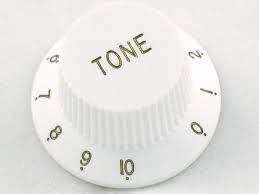
The passive tone control on a guitar
consists of a pot and one cap. Please remember that
passive means a cut only circuit where we can not add
but only subtract high frequencies from the signal.
One side of the cap is hooked to the audio where tone
control is desired. This can either be the master output
(sum of all pickup sounds) or the output of an individual
pickup. The other side of the cap is hooked to the
center terminal (wiper) of the pot. Here we are going
to use the pot as a variable resistor only.
One terminal
of the pot goes unused and the other terminal is
connected to ground. Here is what is happening electronically:
A cap passes high frequencies more than lows. All
caps can pass high frequencies, but according to
the value of the cap in microfarads, it will start
to block low frequencies more and more at progressively
lower frequencies as the value of the cap on microfarads
is increased. |
 |
Therefore if we hooked a
cap without a pot between a signal and ground it would
shunt high frequencies to ground leaving the signal with
only the lower frequencies to pass to the output jack.
Again the range of frequencies shunted to ground is determined
by the value of the cap. If we add the pot back into
this circuit, since it is being used as a variable resistance
between the audio signal and cap, we can use it to control
the amount of signal the cap gets. Therefore we can set
the desired amount of high frequency cut by varying the
pot. One thing to note about this type of circuit. Since
the full resistance of the pot is connected to the circuit
at all times between the signal and the cap, there is
always some amount of tone cut taking place even when
the pot is set for minimum cut. According to how you
want to look at it, either this is the "correct" sound
or it is possible to get more high end from the guitar
by removing the tone control. You may have seen some
Fender guitars with a tone control that has a click at
one end of the pots rotation. This is a switch that enables
the tone control to be switched out of the circuit.
SWITCH
Any guitar that contains more than one pickup contains
a switch to select between its
pickups. Gibson two pickup guitars historically contained
a three way toggle switch to switch between either pickup
or to enable both of them to be played together Standard
today on Fender 3 pickup Stratocasters is a five way switch,
but the early Strats and Telecasters contained three way
switches. In the case of the Strat you were limited to
the choice of the bridge, middle or neck pickups by themselves.
It was later discovered by accident that the switch could
be manipulated between positions and would activate two
of the pickups at once yielding new and useful tones. Therefore
middle and neck or middle and bridge could now be played
together. This was of interest to artists such as Clapton
and Skynyrd who did much to popularize the hollow quacky
type of tone. Other Strat artists such as Blackmore and
Hendrix stuck to using only the individual pickups. But
the standard switch today on a Modern Stratocaster is a
five way.
Much can be done with switching. Aside from a switch selecting
pickups, multi pole 5 way switches can be utilized that
for example to enable tone controls to be switched out
on certain pickups choices or a coil tap on a pickup to
be engaged on certain positions of the switch. Extra toggle
switches can also be added to the control set to add additional
functions to the guitar's wiring. In the case of Gibson
guitars where they use their standard three way toggle
it is necessary to add extra switches to get additional
switching functionality. A good way to do this on a Gibson
is to replace the standard pots with switched pull pots.
Then the extra switching functionality can be wired in
without having to drill holes in the guitar to mount toggle
switches.
JACK
Obviously the main function of the guitar jack is to provide
the connection of a cable to send the guitar's signal
to the amplifier.This jack is often erroneously referred
to as the guitar input jack, but it is actually the output
jack as the signal is coming from and not going to the
guitar. The most important thing about the output jack
is that it be a high quality one. Too many guitars nowadays
have inexpensive
Chinese jacks that are prone to noise, intermittent operation
and early failure. Reigning supreme is still the open frame
Switchcraft 11 series jack. I have seen these jacks still
working well on equipment from the fifties. All that is
needed is too keep its nut tight so it doesn't twist around
and break the wires soldered to it. One type of jack that
is a constant source of problems are the enclosed tunnel
jacks. Even the ones from Switchcraft fail and become intermittent.
They are utilized when the manufacturer wants to drill
only a small whole through an area of thick wood. This
type of jack is extremely popular in basses and some guitars.
Ibanez loves to use these and they fail quite often.
In addition to carrying the guitar signal some jacks
have extra terminals on them to perform other functions.
If a ring/ tip/sleeve (called RTS and also stereo) jack
is used on a two pickup guitar, each pickup can be sent
to a separate amplifier enabling stereo operation. Rickenbacker
basses were set up this way. A stereo Y cable must also
be used to hook up to the two amps. The most popular use
of the stereo jack though is for an instrument containing
active electronics. The negative lead of the battery is
connected to the jack's ring terminal. When a mono 1/4" plug
(no ring terminal) is inserted in the jack, the battery
negative wire is connected to the sleeve of the plug which
also contacts ground completing the circuit and turning
the active circuitry on. When the plug is removed from
the jack the circuit gets turned off as the battery is
no longer making a complete circuit. This also turns off
the battery when the guitar is not in use making it last
longer.
This covers the major components contained in a guitar.Next
month we will build on our new knowledge of pickups and
their associated components and discuss how they interact
with each other to create the guitars tone.
|