|
Hello again, and welcome to another installment
of Luthier's Corner. The holidays are just around the corner,
and shopping for gifts can be somewhat stressful. Well,
as it turns out, back in my second installment, I actually
covered the topic of buying your first guitar or bass.
So I figured, that would be the perfect topic to reiterate
here
Hello
again, and welcome to the second installment of Luthier's
Corner. Last issue, I took the opportunity to introduce
myself, gave a brief history of how I got here, and
discussed, briefly, some of the myriad topics that
I would cover in future installments. Well, for this
issue, I thought it only fitting to discuss what
every guitarist and bassist has to first face when
they are just starting out-buying their first instrument!
I often get asked what's better to start on, acoustic
or electric? Well, the answer depends on a number
of factors. On the one hand, an acoustic guitar will
build strength in your fretting hand because, usually
the strings are heavier than those on an electric,
and the action is generally higher as well. Of course,
those are also the reasons that can be very un motivating
for a new player to want to continue.
Electric guitars are usually easier
to play, but you have to buy an amplifier, a guitar
cable, strap, etc etc. Or at least that's how it
USED to be when I first started out, and the choices
for a quality beginner's guitar back then were fairly
slim, and often times, had bad action, fret buzz,
etc. Today, however, it's never been easier to decide
to take up the guitar or bass and actually find a
beginner's instrument that actually plays fairly
well. There are so many options on the market now
for decently made instruments for under $200, that
it can make your head spin! One of the most popular
ways to buy either an acoustic or electric guitar
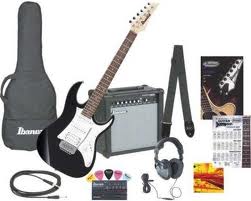
is in a pre-boxed "complete kit" form,
which basically comes with most/all the essentials
one would need to get started on that road to rock
stardom! The kits are cool, because they eliminate
the need to buy all the additional accessories that
go with your new guitar. Most electric guitar kits
come with a small amplifier, strap, gig bag, guitar
picks, extra strings, tuner, even educational materials
like books or cd's. Most acoustic kits come with
a gig bag, strap, picks, tuner, and educational materials
as well.
Other Options
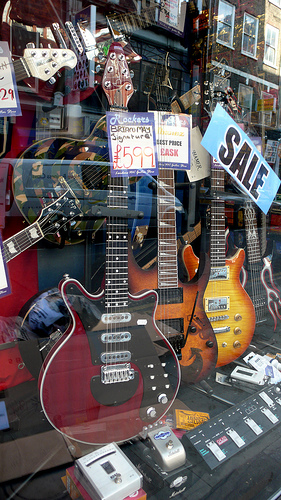
Of course, player kits are by no
means the only way to get started! After all, for
all of their perks, they do have drawbacks, such
as not being able to tell the condition of the frets,
action, etc if the guitar is in a sealed box. Limited
color options are another setback. If you want a
blue electric, but the kit you're looking at only
comes in red, black, or white. Well, either you settle
for one of those, or you look at other options. |
 |
OK, but you're thinking to yourself that
you have no idea how to check the action or frets on a
guitar because you're new to this whole thing. Right? Well,
a simple solution to that sort of problem is to ask an
experienced guitar player friend to go shopping with you
and have that person help you find the right playing guitar.
If you don't know anyone that can go with you, and you
live in the South Florida area, you can always call me
to help with the search. In fact, I often get asked to
get a new guitar for a beginner, and I can actually find
you the ideal instrument, and set it up for the easiest
playing feel before I deliver it into your hands.
Well, back to what kind of guitar is "ideal" for
a beginner. Again, loaded question, as there are many factors.
If you are a rocker at heart that wants to learn to jam
AC/DC or Metallica, well, then you'd probably want to get
an electric guitar that has humbucking pickups. (more on
the different types of pickups in a future issue.) If you
are more of a blues enthusiast and want to learn to wail
like Stevie Ray Vaughan or Buddy Guy, then an electric
guitar with single coil pickups would be more up your alley.
Let's say that your favorite type of music is folk or acoustic
rock, and you wanna really learn some classic Jimmy Buffett
or John Denver tunes, then a good steel string acoustic
is the way to go. If Segovia is your passion, you need
a nylon string classical. Do you want to bop and swing
jazz? Well then, at the very least, a solid body electric
guitar with humbuckers would be the least expensive way
to start getting there, but eventually, you would have
to buy a semi-hollow or hollow body arch top acoustic,
or acoustic electric. That pretty much covers the different
types of guitars and the respective styles for which they
are best suited. Of course there are more, but too much
information can cause overload.
What style of music do you prefer
 |
OK, now that you
have a better idea of what type of guitar you want
to buy, and what style of music you prefer, where
do you go from here? Well, it's a safe bet that no
matter what kind of deal you got on a beginner guitar,
it's probably not set up to the optimal playing feel
at the factory, so that's where someone like me comes
in.
Once you have your new guitar/bass,
it's a good idea to bring it in to a reputable luther
or guitar tech for a full setup. It doesn't usually
cost very much to have the guitar properly "dialed
in",
and you'll be glad you did, and I am more than happy
to help. The bottom line is, you want to be able
to enjoy learning how to play your new instrument.
And the enjoyment isn't always there if your guitar/bass
has very stiff action and feels like a cheese grater.
The beautiful thing about the guitar is that, unlike
other instruments like piano or trumpet, the guitar
is a very personal instrument, wherein they come
in so many styles and colors, inlays, etc! |
Before I go, I would be remised
if I didn't address the "proper" way
to learn the guitar ethos that is usually spoken of. The
ideal way to start learning ANY instrument, of course,
is with a quality teacher guiding you along the path. However,
that is, by no means, the ONLY way to learn to play. Had
Jimi Hendrix received "proper" instruction from
a teacher, he probably would not have become the innovator
he did due to his unorthodox style. There are many other
examples of these exceptions. The bottom line is, however
you decide to learn how to play, stick to it, find a teacher
if necessary, and above all, don't quit just because it
seems difficult to accomplish. No task worth accomplishing
is ever achieved if not pursued with fierce dedication.
Believe in yourself, and make happen that glorious noise
called music! Until next time remember, there is nothing
you can't do if you set your mind to it! Cheers!! |