This month we discuss another misunderstood safety subject
even more important than last month's fuse discussion.
I find a lot of people clueless about how a three pin A/C
plug that connects your equipment to a wall outlet actually
works. I present this information from an educational standpoint.
The A/C wiring in your outlets and equipment contain potentially
lethal voltages. Please don't alter or modify anything
if you are not qualified and have someone who is qualified
do the work. If you are first learning these concepts from
this article I would not consider you qualified.
Let's
start by going back in time and looking at how equipment
was wired years ago. Some of you may be old enough
to remember when A/C plugs had only two pins. This
type of plug has several ways it can cause dangerous
or fatal shock hazards. In the USA Power is delivered
at a very high voltage to a transformer outside your
house which steps it down to 240 volts A/C and is
sent into the building's breaker panels on three
wires. Here it is divided further into two 120 volt
legs of power.
This is done by referencing
each of the hot wires to the third wire called
the neutral, which is the return line of the circuit
and is at zero volts. If voltage
is measured between either of the hot legs and the
neutral you will read 120 volts. The neutral line
and one of the hot legs are wired to an electrical
outlet providing you with 120 volts to use. In the
old days you could insert the plug into the socket
either way and your device would work. |
 |
.Equipment
with a metal chassis like a toaster or vacuum cleaner
were isolated (floating )from the A/C line, so there
is was no danger of a shock hazard if the chassis
was touched. The problems begin when you start plugging
in devices that connect the chassis to the A/C line.
This is especially a problem in audio gear because
the chassis gets referenced to one side of the A/C
line to enable it to act as a noise reducing shield.
Let's follow this through. Suppose we
have an old guitar amp with a two wire plug. It gets
plugged in the wall and the chassis gets its ground reference
to one side of the A/C line. Now suppose the person playing
guitar through that amp also sings. He steps up to a
microphone connected to an amplifier whose plug is in
the socket with reversed polarity to the first amp, making
the chassis of the amp connected to it be at a 120 volt
potential to the chassis of the guitar amp.
Therefore
since the guitar is grounded to the chassis of the guitar
amp and the mic is grounded to the chassis of the PA amp,
what do you think happens? Since the guitar player is touching
the strings of the guitar he is grounded to it also. When
he starts to sing into the mic a direct connection is made
completing the 120 volt circuit through his lips. OUCH!!!.
I read an interview once where Jerry Garcia of the Dead
said he was being shocked by the mic all the way through
his set at Woodstock so it could happen anywhere. Of course
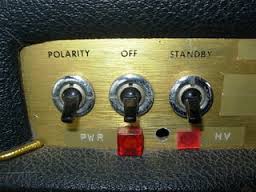
at the time the solution to this problem was the ground(polarity)
switch which enabled you to reverse the polarity of the
amplifiers chassis reference to prevent hum or electrocution
(not necessarily in that order of importance). This is
a halfway solution by referencing the chassis to the A/C
line through a capacitor (now referred to as the death
cap). The cap was connected to a switch which according
to which one of the two ways switch was thrown would reference
the hot at 120 volts or the neutral at 0 volts to the chassis
through the cap. This cap, without getting too much into
theory, was very effective at letting radio frequency and
noise through it to ground, but due to its capacitance
value could block most of the 60 HZ A/C from reaching the
chassis. Therefore if you did have the hot referenced to
ground on one amp and the neutral on the other, you would
probably only feel a small tickle of a shock warning you
to throw the polarity switch to correct the problem. Now
for why we call it the death cap. The cap is effective
at blocking the 60 HZ 120 volt A/C, that is until it fails.
And most of the time when a cap fails it shorts making
it the equivalent of a piece of wire. In this situation
we are right back to directly referencing the chassis to
the A/C line and it is again a hazard. Back in the days
when these type of polarity circuits were designed, the
designers were not required to think about safety. And
they probably weren't anticipating in 1964 that the amp
would still be in use in 2014. Think carefully about that.
If the death cap is present in an amp you are using, you
are depending upon a cap that is close to fifty years old
to protect you from a potentially fatal shock. That is
why I insist on informing the owner of every vintage amp
I receive for repair and insist that we modify the A/C
primary wiring to modern code. If the customer objects
to this because he wants to keep the amp completely original
from a collectible standpoint, we make him sign our disclaimer
where he states we informed him of the risk and agrees
to hold us harmless from any injuries he receives.
socket one way only
As time moved on the safety regulatory
agencies modernized the way equipment interfaced with the
A/C line. The first thing they did was make the plug insert
into the socket one way only, making all equipment have
the same polarity as long as the unit's internal wiring
was correct. Unfortunately they didn't do away with the
polarity switch so you could still fool with the chassis
A/C line reference.They also made mandatory that after
the hot A/C wire entered the chassis it was hooked to the
rear of the fuse holder. This insured that if a blown fuse
was removed with the unit still plugged in the hot A/C
wire was too far away from your finger to be touched and
shock you. The other side of the fuse holder was required
to go to the power switch further insuring that if the
unit was turned off no power was present in the chassis
that could shock someone.The power switch output went to
one transformer primary wire and the neutral wire was required
to be hooked to the other transformer primary wire. Manufacturers
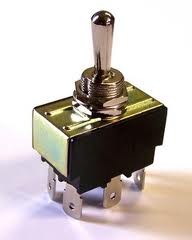
were slow to adopt these measures. I work on many vintage
amplifiers and see all types of wiring. It was easy and
faster to use the terminals of fuse holders and switches
as a hookup place for the A/C power cable so you often
saw the hot go to the fuse holder and the neutral to the
power switch. I saw this on an old Music Man amp just yesterday.
 |
The
other major change was the addition of the 3rd pin
ground. The wire from this third pin is required
to bolt to the chassis somewhere by itself on its
own bolt. The third pin on the socket is wired to
earth ground through the buildings electrical wiring,
which is usually a long metal rod hammered into the
ground nearby. What this third pin does is shunt
any high voltage that comes in contact with the chassis,
for example a 400 volt wire that has broken loose,
and shunts its voltage to ground through the third
pin rather than to ground through your body. It also
ties the chassis to ground making it a shield against
noise and hum pickup, which is a better way to do
this than the polarity switch.
Pieces of equipment hooked together
with reversed A/C polarity on their chassis can be
dangerous and costly. Even if you have equipment
that is designed safely, if the outlets in the building
are not wired correctly there can be problems. I
once saw someone connect a snake between the amps
on the stage and the mix console at the back of the
room. It arc welded an Impressive hole in an XLR
connector.This same club burned to the ground several
years later from an electrical fire. I have seen
my share of mixers on my service bench that experienced
damage from reverse polarity A/C. |
This usually will burn up the ground traces
on all the PC boards inside as they are the part of the
circuit that have the least current handling capability.
It can get very messy. If you gig frequently at different
venues a good inexpensive tool to carry is an outlet checker.
This is a little device you plug first into any outlet
you want to use and it has lights on it to indicate whether
the hot, neutral and ground on the outlet are wired correctly.
It is only about a $10 item and should be available from
Radio Shack.
One other related item to the A/C wiring is the Ground
Loop. Audio signals prefer one path to ground. Unfortunately
most audio systems are made of multiple units hooked together
creating multiple separate points for the grounding. For
instance, if we are using a Keyboard and an amplifier,
there are ground points at the audio output jack and 3rd
pin ground. The same goes for the amplifier. When the two
units are connected together if there is even the smallest
resistance in one of the ground paths a voltage occurs
across it that gets amplified. This voltage is at the 60
HZ frequency of the 120 volt power and can be mildly to
very annoying according to the size of the resistance in
the loop. The obvious thing to do is to eliminate the ground
loop but the two easiest solutions have problems. If you
lift the 3rd pin ground on one of the units the ground
loop is eliminated and the hum stops. But you have also
defeated the safety ground of the unit and are now depending
on the audio cable ground connected to the other unit as
your safety ground connection. This should never be done
as it is extremely unsafe. Another solution is too open
the ground connection at one side of the audio wire. This
will work ,is safe and the wire shield still works being
connected still at one end, but leaves you to make modified
special cables only good for that application. Eliminating
a ground loop safely can be tricky and is often dependent
upon specific circumstances, so the only advice I give
here is to make sure you do it safely. It is always frustrating
to explain to someone who brings me a piece of equipment
that is suffering from a ground loop problem, that his
equipment is not broken it is an interface problem.
Again I stress to be safe and not modify anything directly
hooked to the A/C line unless you completely understand
what you are doing. It is easy to do it wrong and create
a hazard. Just the other day we had an amplifier come in
that didn't work because the customer replaced the A/C
plug and reversed the ground and hot wires! Any one with
questions on this topic feel free to email me and I will
try to help you.
Steve
Weiss is the owner and main technician of Steve Weiss
Electronics Inc. He is experienced in the repair
of analog and digital musical equipment. This includes
everything from Vintage Tube Amps and Pro Audio equipment
to Digital Keyboards There is also a guitar repair
shop staffed by some of the areas top guitar repair
techs. He is authorized for warranty work on most
major brands. Steve Weiss Electronics is located
inside of Sam Ash Music at 5460 West Sample Road
Margate, FL 33073 954-975-3390 Ext 272. Steve has
also spent 25 years on the road as a performing guitarist
and is the designer of Primal Guitar amps that can
be seen at Primal
Audio.com Steve can also be reached at stevew@metromusicmayhem.com |
|
|